
How to Evaluate AI Lease Due Diligence Platforms

AI lease due diligence platforms are becoming more important in multifamily acquisitions. Lease-level risk is difficult to catch manually at scale.
Acquisition teams often review hundreds or thousands of documents under compressed timelines. These include lease agreements, rent rolls, addenda, ledgers, and resident files. A traditional lease review process can catch obvious issues, but hidden discrepancies often remain buried until after closing.
The best AI lease due diligence platforms do not just extract lease terms. They help teams validate data and reconcile records. They score risk and surface issues that may affect underwriting, NOI, or post-close operations.
Machine learning identifies patterns across thousands of documents. These patterns reduce risk. They also help teams make more informed decisions before teams commit capital. AI driven analysis also reduces manual review time significantly, freeing acquisition teams to focus on strategic decisions rather than document processing.
Traditional due diligence methods have been manual and people-focused. More volume usually meant more employees. AI promises to completely change lease administration, property management, and due diligence.
Companies that adopt early gain a decisive competitive advantage. NAIOP documents why this shift is already underway →
For related acquisition workflows, see hidden lease due diligence risks in multifamily acquisitions →

What AI Lease Due Diligence Platforms Actually Do
AI lease due diligence platforms support the lease management review process during acquisitions. They analyze documents and compare them against operational data.
They can help review:
- lease agreements
- addenda
- rent rolls
- concessions
- resident records
- billing data
- ledgers
- renewal terms
The purpose is to identify where the documents, system data, and financial assumptions do not align.
This is especially important in commercial real estate due diligence. Investors need to confirm whether actual lease-level data supports projected income. Managing lease portfolios at acquisition scale requires AI tools that go beyond basic document review. This applies across hundreds of units and multiple property types.
AI driven analytics enhance risk assessment and due diligence. They reduce uncertainty and enable investors to make informed decisions. NAIOP documents how these tools align financial and operational goals →
Evaluation Criteria 1: Lease Abstraction AI
Lease abstraction AI extracts key terms from lease documents.
A strong platform should identify:
- rent amount
- lease start and end dates
- renewal terms
- concessions
- fees
- deposits
- addenda
- special clauses
But extraction alone is not enough.
The platform should also explain how it measures confidence. If AI tools pull a rent amount from a lease, acquisition teams need to know whether that value is reliable. They also need to know whether it is uncertain or requires human review.
This is the difference between basic data extraction and true commercial real estate due diligence support. AI powered lease abstraction that explains its confidence levels helps teams prioritize human review. Teams focus on the documents that matter most, not everything manually.
Evaluation Criteria 2: Contract Review Automation
Contract review automation helps teams move faster through high-volume document sets.
In multifamily acquisitions, this matters because the review window is often short.
A platform should help teams:
- classify documents automatically
- identify missing files
- flag incomplete leases
- surface unusual terms
- organize review priorities
Good contract review automation reduces manual effort. Great automation helps teams focus on the highest-risk documents first. Machine learning improves prioritization over time. It identifies which document types and clause patterns most closely correlate with lease administration errors and revenue leakage.
What once took a lease administration team five to seven days now takes minutes. AI processes large quantities of documents, transforming lease administration workflows. The immediate impact is teams reducing redundancy and completing tasks faster. NAIOP documents how this is reshaping acquisition timelines →
Evaluation Criteria 3: Document Analysis for Leases
Document analysis for leases should go deeper than OCR.
The platform should understand lease logic.
For example:
- Does pet fee in the lease appear in the billing data?
- Does the concession end date match the rent roll?
- Does the renewal document match the active lease term?
- Do the lease files include all required addenda?
- Is the lease signed and enforceable?
Surface-level data extraction may pull text. A stronger platform interprets what that text means in an operational context. This distinction between raw data extraction and contextual document analysis for leases determines whether the platform actually reduces manual review or simply digitizes it.
Strong document analysis for leases helps teams ensure compliance with policy standards. It also reduces risk from incomplete or inconsistent documentation.
Evaluation Criteria 4: Data Reconciliation
This is one of the most important capabilities.
AI lease due diligence platforms should reconcile:
- lease documents
- rent roll data
- PMS records
- ledgers
- billing schedules
The goal is to identify mismatches before close.
For example: A lease may show $1,950 base rent, while the rent roll shows $1,875. That difference may look small, but across a portfolio it affects underwriting accuracy.
AI driven reconciliation eliminates the human error that manual cross-referencing introduces. It also gives managing lease teams and asset managers a clearer picture of actual lease portfolio performance. They gain this visibility before the deal closes.
For deeper reconciliation context, see real-time lease report reconciliation workflows →
Evaluation Criteria 5: Lease Audit and Risk Assessment
Lease audit and risk assessment should help teams prioritize findings.
Not every issue carries the same weight.
A missing signature is different from a $200 monthly underbilling issue across 50 units.
A strong platform should help classify risk by:
- financial impact
- compliance exposure
- operational urgency
- confidence level
- portfolio pattern
Risk scoring helps acquisition teams move from raw findings to better strategic decisions. It also helps teams ensure compliance by surfacing which issues require immediate action. Teams can address lower-priority items post-close. Machine learning models improve this scoring over time, learning which risk patterns most reliably predict post-close performance problems.
Evaluation Criteria 6: Revenue Leakage Detection
Revenue leakage often hides inside lease details.
Common examples include:
- missing parking fees
- unbilled pet rent
- utility charges not applied
- expired concessions still active
- incorrect renewal rents
AI tools should detect these issues before they distort the acquisition model. Every missed charge represents a gap between projected and actual lease portfolio performance. AI powered lease abstraction tools validate charges against rent roll data. They catch discrepancies before they affect underwriting assumptions.
For related lease audit controls, see 10 ways automated lease audits stop revenue leaks →
Evaluation Criteria 7: Workflow and Review Management
A due diligence platform should not simply produce a long list of issues.
It should support action.
Useful workflow features include:
- reviewer assignment
- status tracking
- issue categorization
- escalation rules
- exportable summaries
- audit trail visibility
Acquisition teams need to track what they have reviewed and what remains unresolved. They also need to know which issues should affect pricing or closing conditions.
Strong workflow management also supports lease administration continuity post-close. It ensures teams track flagged diligence issues through to resolution, rather than losing them in the transition.
Evaluation Criteria 8: Portfolio-Scale Review
For large acquisitions, sampling is often not enough. The platform should support large-scale lease review across full portfolios.
This matters when teams are reviewing:
- hundreds of units
- multiple properties
- different lease formats
- legacy documents
- mixed data sources
The stronger the platform, the less the team has to rely on manual sampling. AI driven review at portfolio scale gives managing lease teams and acquisition professionals the informed decisions they need. It removes the human error that sampling-based approaches introduce.
Where SurfaceAI Fits in This Guide
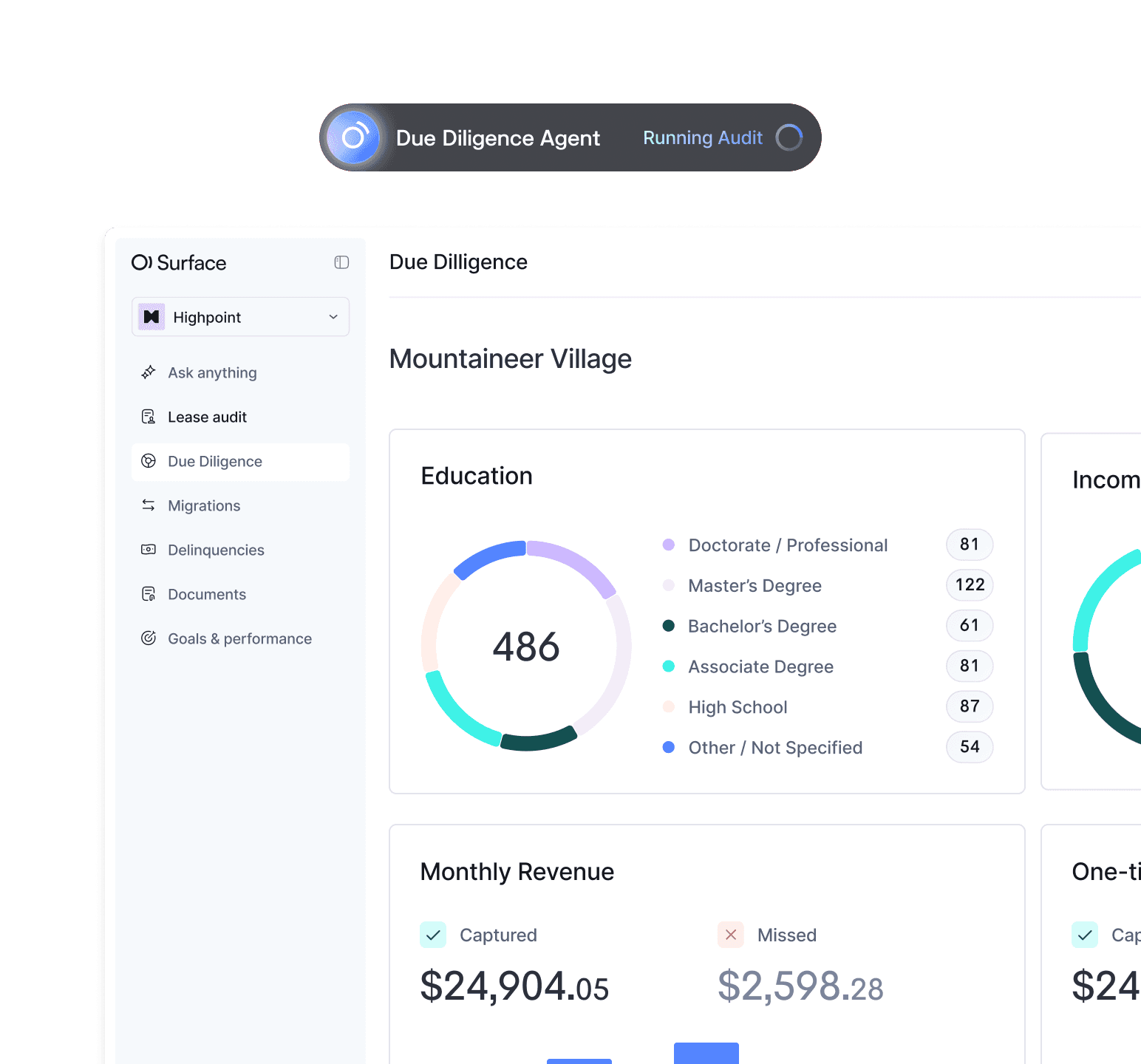
SurfaceAI fits directly into the validation, reconciliation, and risk assessment layer of lease due diligence.
It does not replace the acquisition team’s judgment. It strengthens the underlying review process by helping teams:
- analyze lease documents at scale
- compare lease terms with rent roll and PMS data
- detect discrepancies tied to revenue leakage
- surface lease compliance risks
- support faster due diligence workflows
- improve confidence before close
SurfaceAI moves lease management review from manual sampling to broader lease portfolio-level validation. It reduces manual effort and minimizes human error. Teams make better strategic decisions before they commit capital.
How to Compare AI Lease Due Diligence Platforms
Use this decision framework:
1. Document Coverage
Can it read the right documents?
The platform should handle leases, addenda, renewals, ledgers, rent rolls, and related resident files.
2. Data Reconciliation
Does it reconcile data across systems?
Data extraction is not enough. The platform must compare documents against operational data to reduce risk from hidden discrepancies.
3. Risk Scoring
Does it prioritize findings by impact?
Teams should rank findings by financial and compliance impact. AI tools that score risk help teams make faster strategic decisions.
4. Human Review Support
Does it make reviewers faster?
AI driven platforms should accelerate human review, not remove oversight entirely. AI handles volume. Humans handle judgment. Together they reduce human error.
5. Portfolio-Scale Coverage
Can it handle the full acquisition?
The platform should support more than a small sample of files. True lease portfolio coverage is the standard.
6. Decision-Ready Outputs
Does it produce outputs teams can act on?
Acquisition teams need clear summaries that support pricing, negotiation, and post-close planning. These outputs enable informed decisions, not just raw data.
Common Mistakes When Evaluating Platforms
Teams often make three mistakes.
First, they overvalue data extraction and undervalue reconciliation. AI powered lease abstraction that pulls lease terms is usefu, but the real value comes from validating them against rent roll and billing data.
Second, they treat all findings equally. Without risk scoring, teams waste time on low-impact issues while missing material ones. Lease audit and risk assessment prioritization is what separates AI tools that help from those that add work.
Third, they choose tools that create more work. If a platform produces outputs that still require heavy manual cleanup, the AI driven efficiency gain disappears. Teams face the same human error risks they started with.
Key Takeaway
AI lease due diligence platforms should help acquisition teams answer one critical question:
Can we trust the lease-level data behind this deal?
The best platforms combine:
- lease abstraction AI
- contract review automation
- document analysis for leases
- reconciliation workflows
- lease audit and risk assessment
- portfolio-scale review
That combination helps teams move faster without reducing diligence quality. It supports the informed decisions and strategic decisions that protect returns after close.
Conclusion
Multifamily acquisitions are increasingly data-heavy, document-heavy, and time-sensitive.
AI driven platforms combine machine learning, AI powered lease abstraction, and lease administration automation. They give acquisition teams the confidence to move faster without sacrificing diligence quality.
They reduce risk, minimize human error and help teams ensure compliance. AI driven platforms turn reviewing leases from a bottleneck into a competitive advantage. 72% of real estate owners and investors are already budgeting for AI-enabled solutions.
AI adoption in property management jumped from 20% in 2024 to 58% in 2025. Teams that have not yet adopted AI tools for commercial real estate due diligence are falling behind. NAR documents this shift and what it means for the industry.
Book a demo to see how SurfaceAI supports faster, more reliable acquisition diligence. See how it improves visibility into lease risk, revenue leakage, and data reconciliation.
Frequently Asked Questions About AI Lease Due Diligence Platforms