
Automated Lease Audits to Find Revenue Leaks in 2026

Revenue leakage in multifamily operations rarely comes from one large mistake.
More often, it comes from hundreds of small discrepancies spread across leases, billing records, concessions, renewals, and resident accounts.
A missing parking charge on one unit. An expired concession still applied on another. A renewal increase never reflected in billing.
Individually, these issues may seem insignificant. Across a lease portfolio, they directly impact NOI and cash flow.
That is why multifamily operators are increasingly adopting automated lease audit and review software to monitor lease compliance continuously and surface revenue leaks earlier.
This guide explains how automated lease audits work, how modern systems reconcile operational data, and why continuous validation is replacing periodic manual processes.
For broader monitoring workflows, see lease compliance monitoring setup for multifamily →
What Is Automated Lease Audit and Review Software?
This software helps multifamily teams validate operational data continuously by comparing:
- executed leases
- rent roll data
- billing records
- resident ledgers
- concession schedules
- renewal terms
The goal is to identify discrepancies tied to:
- revenue leakage
- lease compliance issues
- reporting inaccuracies
- operational risk
- data integrity gaps
Unlike traditional audits, modern systems support ongoing monitoring rather than one-time review cycles.
Why Revenue Leakage Happens in Multifamily Portfolios
Revenue leakage often develops through operational inconsistencies rather than intentional errors.
Common causes include:
- missing ancillary charges
- incorrect base rent entries
- concessions extending beyond expiration
- renewal pricing not updated
- billing mismatches across data sources
- incomplete lease documentation
- human errors during lease administration
These problems are difficult to detect manually at scale.
Why Manual Lease Audits No Longer Scale
Traditional multifamily lease auditing workflows often rely on:
- spreadsheets
- sampling methods
- periodic reviews
- fragmented reporting
As portfolios grow, this approach becomes increasingly difficult to maintain.
Manual review creates several challenges:
- delayed issue detection
- inconsistent review quality
- operational blind spots
- limited portfolio visibility
- time consuming reconciliation cycles
This is especially problematic for operators managing large portfolios or acquisition transitions, where finance teams need fast, reliable answers.
According to the 2025 AppFolio Property Management Benchmark Report, 43% of property managers cite maintaining high occupancy as their top concern. Protecting NOI is one of the fastest-growing operational pressures. Rising insurance costs, flat rental income, and operational inefficiencies are compressing margins. That makes revenue leakage from billing errors and missed charges an expensive problem.
How Automated Lease Audits Work
Modern automated lease audit systems follow a structured reconciliation workflow.
Step 1: Aggregate Lease and Operational Data
The system gathers information from:
- lease documents
- PMS platforms
- rent rolls
- resident ledgers
- billing systems
This creates a centralized operational dataset that consolidates fragmented data sources.
Step 2: Extract and Standardize Lease Terms
The platform identifies and organizes key lease data such as:
- base rent
- fees
- concessions
- renewal terms
- lease dates and critical dates
- utility obligations
This allows standardized analysis across the portfolio and ensures consistent treatment of every lease.
Step 3: Reconcile Lease Terms Against Operational Data
The software compares lease information with:
- rent roll records
- ledger activity
- active billing charges
- operational system data
This reconciliation process is where most revenue leaks are identified.
For deeper reconciliation workflows, see rent roll to lease reconciliation for multifamily M&A →
Step 4: Detect Revenue Leak Patterns
The platform helps teams identify discrepancies such as:
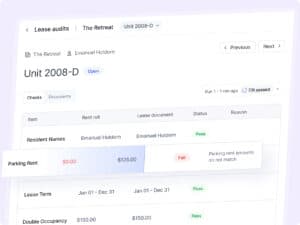
- missing pet or parking fees
- underbilled rent
- expired concessions still active
- incorrect renewal rates
- billing gaps across systems
This supports revenue leak detection at scale.
Step 5: Trigger Real-Time Lease Compliance Monitoring
Modern systems increasingly support real-time lease compliance monitoring by generating alerts when:
- lease terms conflict with billing
- required documentation is missing
- fees are inactive
- policy violations appear
This reduces the time between issue creation and issue resolution, helping teams reduce risks before they compound.
Step 6: Prioritize Exceptions for Review
The best systems use exception-based review workflows.
Instead of reviewing every lease manually, teams focus on:
- high-impact discrepancies
- unresolved exceptions
- high-risk findings
This improves operational efficiency significantly and supports stronger audit readiness across the portfolio.
Revenue Leaks Automated Audits Commonly Detect
Missing ancillary charges. Pet fees, parking, utilities, and storage charges often fail to activate correctly.
Incorrect rent entries. Lease terms and PMS records may not match, creating a recurring billing error.
Renewal errors. Renewal increases may not flow into billing systems correctly.
Concession mismanagement. Temporary discounts may continue beyond approved periods.
Incomplete lease files. Unsigned or missing documents create compliance and enforceability risk.
These are among the most common issues found during multifamily lease auditing.
NOI accuracy depends on lease-level data. The NMHC Industry Benchmarks track NOI as a percentage of total revenue. Every undiscovered billing error, missed charge, or incorrect concession reduces that figure. Reliable performance reporting starts with accurate rental income, rental losses, and ancillary charges.
Where Automated Lease Audits Matter Most
Ongoing Portfolio Operations
Continuous monitoring improves operational consistency, reporting accuracy, and the quality of financial reports leadership relies on.
Acquisition Due Diligence
AI lease due diligence workflows increasingly rely on automated lease review to validate underwriting assumptions during lease review for acquisitions.
For acquisition workflows, see how to scale multifamily lease due diligence →
Property Transitions
System migrations and ownership changes often introduce billing inconsistencies and data gaps.
Asset Management Oversight
Asset managers need portfolio-wide visibility into operational risk management and revenue exposure.

Where SurfaceAI Fits in Automated Lease Auditing
SurfaceAI functions as an operational intelligence and validation layer across multifamily systems.
Rather than replacing the PMS, SurfaceAI helps teams:
- analyze lease documents at scale
- reconcile lease terms with rent rolls and ledgers
- identify discrepancies tied to revenue leakage
- automate compliance monitoring in real time
- improve visibility across multifamily portfolios
This helps operators move from reactive audits toward continuous operational oversight.
For related operational controls, see 7 features of automated lease audit software →

“I'm really loving lease audits. Very user friendly. Very black and white - tells you that this is exactly what you need to fix. Instead of having search for a needle in the haystack.”
Gary Robbins, Transitions Manager
How Automated Audits Improve Asset Performance
Strong lease auditing workflows help operators:
- improve NOI accuracy
- reduce billing inconsistencies
- strengthen compliance oversight
- improve reporting confidence
- accelerate issue resolution
This becomes increasingly valuable as portfolios scale.
Common Mistakes Operators Make
Relying only on periodic audits. Issues often emerge between scheduled review cycles.
Reviewing only samples of leases. Sampling can miss portfolio-wide discrepancies.
Treating lease audits as purely financial. Operational workflows and system accuracy matter equally.
Assuming PMS data is automatically accurate. Most PMS systems store operational data but do not validate it continuously.
Key Takeaway
Automated lease audit and review software is changing how multifamily operators approach operational oversight.
The goal is no longer simply reviewing leases periodically. It is continuously validating operational accuracy across the portfolio.
Conclusion
As multifamily operations become more complex, manual lease review processes struggle to keep pace.
Automated lease audits help operators identify revenue leaks earlier, improve lease compliance, and strengthen operational visibility across the portfolio.
If your organization is evaluating automated lease audit software and wants stronger revenue protection and operational intelligence, book a demo to see how SurfaceAI supports continuous multifamily lease auditing at scale.
Frequently Asked Questions About Automated Lease Audits