
7 Features of Automated Lease Audit Software in 2026

Multifamily operators are no longer asking if they should audit leases.
They are asking how to do it continuously, accurately, and at scale.
Traditional lease audits manual reviews, spreadsheets, and periodic checks, are increasingly difficult to sustain across growing portfolios.
Teams focused on protecting NOI, improving compliance, and reducing operational friction are prioritizing automated lease audit software.
But not all tools deliver the same value.
Below are the seven capabilities that matter most when evaluating modern lease audit solutions in 2026.
Regulation imposed by all levels of government accounts for an average of 40.6% of multifamily development costs. Housing providers must balance a wide array of compliance concerns. These include AI, revenue management, rent control, evictions, and financial screening. NMHC documents why automated controls are becoming essential for managing this complexity →
For broader context, see real-time lease report reconciliation workflows →
1. Real-Time Audit Alerts
The most important shift in lease auditing is timing.
Older workflows identify issues weeks or months after they occur.
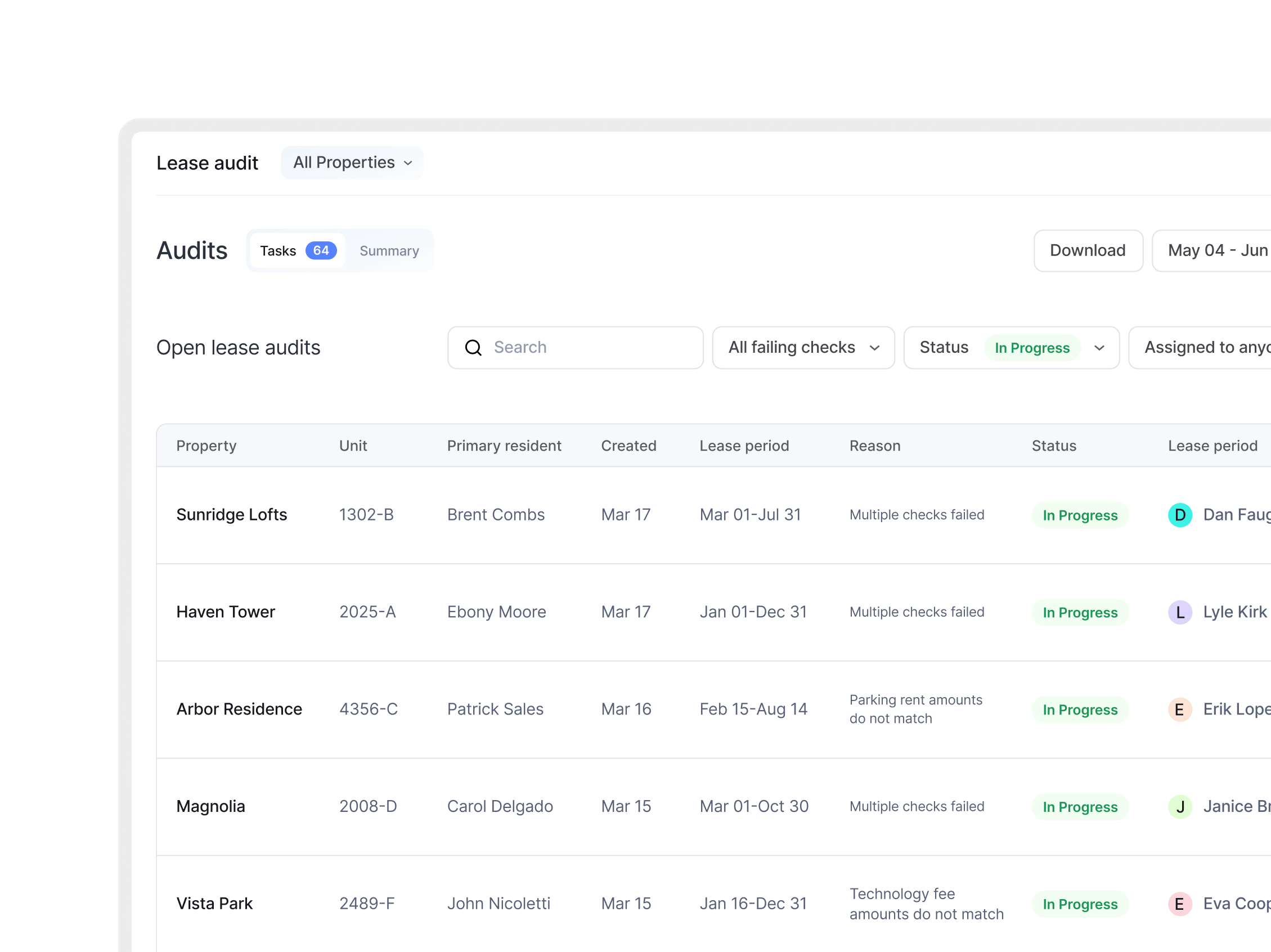
Modern systems generate real-time audit alerts the moment issues appear. These include a lease signed incorrectly, a fee missing from billing, a renewal entered incorrectly, or a concession applied beyond its intended period.
This reduces the lag between issue creation and resolution.
It also supports faster operational response across multifamily portfolio lease audits.
2. Lease Compliance Monitoring at Scale
Lease compliance monitoring ensures that all lease documents and terms meet internal policies and regulatory requirements.
This includes detecting missing signatures, incomplete addenda, incorrect lease structures, outdated documentation, and inconsistent execution across properties.
Manual compliance checks often rely on sampling.
Automated systems can monitor entire portfolios continuously. Today’s multifamily industry uses business intelligence and analytics to make decisions that create better resident experiences and healthier bottom lines.
Apartment operators use cutting-edge technology and analytical systems to price, market, operate, and maintain their communities. Compliance and data accuracy sit at the core. NMHC documents how the multifamily industry has embraced this shift →
3. Revenue Leakage Detection
Revenue leakage detection is one of the primary reasons operators adopt automation.
Common leakage points include missing pet or parking charges and incorrect base rent. Expired concessions still being applied are another source. Unbilled utilities and inconsistent ancillary income round out the list.
Automated systems compare lease terms against billing records to identify discrepancies early.
For practical examples, see 10 ways automated lease audits stop revenue leaks →

4. Property Management Software Integration
Strong property management software integration is critical.
Without it, findings remain disconnected from operational workflows.
Operators should evaluate whether the system connects to their PMS and how frequently data is synced. They should also check whether discrepancies tie back to resident records. Finally, they should confirm whether workflows can be triggered directly from findings.
Integration depth often determines whether a tool is actionable or just informative.
For system architecture context, see property management software solutions across portfolios →
5. Multifamily Portfolio Lease Audits Across Assets
Many tools work at the single-property level but struggle to scale.
Modern platforms should support multifamily portfolio lease audits across multiple communities and different property types. They must also handle varying lease structures and large unit counts.
This allows leadership teams to compare performance, identify patterns, and prioritize risk across the portfolio.
6. Lease Report Validation and Data Reconciliation
A key capability is validating that different data sources align.
This includes comparing lease documents, rent roll data, billing records, and ledger entries.
Lease report validation ensures that what is signed, entered, billed, and reported all match.
Without reconciliation, reporting accuracy is compromised.
7. Workflow Automation for Issue Resolution
Identifying problems is only part of the process.
Strong platforms also support task assignment to site teams, tracking issue resolution, escalation workflows, and audit trails for compliance.
This turns audits into actionable operations rather than static reports.

Where SurfaceAI Fits
SurfaceAI is designed to support multifamily operators as an intelligence layer on top of existing systems.
SurfaceAI does not replace PMS platforms. It monitors lease compliance continuously and detects revenue leakage in real time. It also validates lease data against system records, surfaces discrepancies, and improves operational visibility.
This makes it especially relevant for organizations managing large portfolios where manual lease auditing becomes difficult to scale.
For related controls, see lease auditing and automation systems →

“I’ve been thoroughly impressed with the Surface AI lease audit product. It’s exceptionally user-friendly, and the audit results are clear, concise, and easy to interpret. The impact on our student teams has been tremendous—what once took several days can now be completed in just a few hours. The tool also makes it simple to identify and address issues efficiently. I can’t speak highly enough about the value this product brings.”
Amanda Pour, Operations Compliance Manager
How to Evaluate Automated Lease Audit Software
When comparing tools, focus on speed of detection, real-time audit alerts vs periodic checks. Also evaluate integration depth, breadth of compliance coverage, and ability to quantify revenue impact. Scalability across properties and workflow capabilities for resolution complete the picture.
Features matter, but execution matters more.
Why These Features Matter in 2026
The operating environment has changed.
Multifamily teams are dealing with tighter margins, increased cost pressure, higher expectations for reporting accuracy, and leaner staffing models.
That makes automation not just a convenience, but a necessity.
Key Takeaway
The best automated lease audit software does more than identify issues.
It helps teams detect problems earlier, act faster, protect revenue, maintain compliance, and scale operations efficiently.
Conclusion
Lease auditing is evolving from a periodic finance task into a continuous operational control.
The tools that win in 2026 combine real-time audit alerts with strong property management software integration. Actionable workflows are the third essential element.
Book a demo to see how SurfaceAI supports multifamily teams in real time. See how it improves lease compliance monitoring, revenue leakage detection, and portfolio visibility.
Frequently Asked Questions About Automated Lease Audit Software