
Best CRM for Real Estate Investors in 2026

Most CRM content in real estate is written for agents.
The problem is that investors operate differently.
A broker managing residential transactions, a multifamily acquisitions team evaluating opportunities, and a property owner managing relationships across a portfolio all have different requirements.
That means the best CRM for real estate investors is not necessarily the best CRM for a realtor.
Investors need systems that support:
- acquisitions workflows
- deal pipelines
- broker relationships
- lender relationships
- ownership reporting
- portfolio growth
- operational visibility
This guide explains what investors should look for. It covers how CRM requirements differ across real estate sectors. It also covers how AI is changing relationship management.
For broader investment technology context, see best AI tools for real estate investors →
Why Investors Need a Different CRM Than Agents
Most realtor CRM platforms are built around:
- lead generation
- listing management
- transaction workflows
- client communication
Investors focus on different objectives.
Examples include:
- sourcing acquisition opportunities
- tracking brokers
- managing lender relationships
- monitoring deal pipelines
- coordinating due diligence
- supporting asset management teams
CRM software for real estate investors needs different functionality than CRM software for agents. The same gap shows up between the best CRM for realtor workflows and the systems institutional acquisitions teams need.
eSignature and social media remain the most widely used tech tools among Realtors, at 79% and 75% adoption. AI adoption has reached 68% of agents.

The Best CRM for Real Estate, Investors Should Include
Deal Pipeline Management
Investors need visibility into:
- sourced opportunities
- active deals
- underwriting status
- diligence progress
- negotiation stages
A CRM should help teams manage opportunities from first contact through closing.
Relationship Management
Strong real estate customer relationship management helps investors track:
- brokers
- lenders
- owners
- operators
- property managers
- capital partners
Relationships often drive future deal flow.
Activity Tracking
The best real estate CRM systems help teams maintain institutional knowledge by tracking:
- meetings
- calls
- emails
- introductions
- follow-up tasks
This becomes increasingly valuable as teams grow. Activity history is one of the most underrated key features in any CRM tool. It matters most in real estate businesses where individual relationships drive long-term deal flow.
Workflow Automation
Modern CRM platforms increasingly support:
- task management automation
- reminders
- follow-up workflows
- reporting alerts
Automation reduces administrative work and improves consistency. It saves time for real estate professionals who would otherwise spend hours on manual follow-up.
Reporting and Analytics
Executives need answers to questions such as:
- How many deals are active?
- What stage is each opportunity in?
- Which brokers generate the most opportunities?
- Where are bottlenecks occurring?
This is where top CRM for real estate platforms create value. Strong reporting and analytics turn raw activity data into pipeline visibility leadership can act on.
CRM Requirements by Real Estate Segment
Different roles in real estate need different CRM functionality. A simple real estate CRM that works for an individual agent may fail at the team or institutional level.
Real Estate Agents
Typically prioritize:
- prospect management
- lead nurturing
- marketing workflows
- transaction tracking
Most CRM programs for realtors are built around these needs.
Commercial Real Estate Brokers
Need:
- relationship management
- pipeline visibility
- market coverage tracking
This is why many brokers search for the best CRM for commercial real estate brokers rather than agent-focused platforms. CRM for brokers requires more emphasis on long-cycle relationships than on lead capture.
Property Developers
Typically require:
- investor management
- project stakeholder coordination
- partner communication
This is the territory of CRM for property developers.
Property Management Teams
Focus on:
- resident communication
- operational workflows
- owner reporting
This is the territory of CRM property management software and CRM for property management. Property management CRMs usually integrate with the PMS. They rarely act as the primary system of record.
Real Estate Investors
Require a combination of:
- relationship management
- acquisitions tracking
- diligence workflows
- portfolio visibility
This creates a distinct use case. The best CRM for real estate investors looks different from a residential estate agency CRM. The work itself is different.
How AI Is Changing Real Estate CRM Systems
Historically, CRM systems served primarily as databases.
AI is transforming them into intelligence platforms.
Modern CRM capabilities increasingly include:
- automated follow-ups
- relationship scoring
- activity summaries
- opportunity prioritization
- workflow recommendations
This improves decision-making rather than simply storing information.
AI also helps sales team members and acquisitions teams prioritize where to spend their time. Instead of treating every contact equally, the system surfaces relationships and opportunities most likely to convert.
That shift matters more for investors than for agents. Investor deal cycles are longer. Relationships compound over years.
Acquisitions teams need a CRM that remembers every broker conversation across a five-year sourcing window. That is a different system from one built for transactional residential sales.
AI is now standard in sales. Only 8% of sales reps don’t use AI at all. Those who do say AI and automation deliver better returns than any other sales tool. According to HubSpot, 45% of sellers still rely on general-purpose chatbots like ChatGPT.
Only 19% use AI features built directly into their CRM. That creates a clear adoption gap. Teams that embed AI into the actual sales workflow gain an edge over teams running it outside the system.
Why CRM Alone Is Not Enough for Multifamily Investors
A CRM helps manage relationships and opportunities.
It does not validate operational risk.
As acquisitions progress, investors also need visibility into:
- lease compliance
- rent roll accuracy
- diligence findings
- revenue leakage
- operational discrepancies
This is where CRM systems and operational intelligence systems serve different purposes. A CRM tracks who you know. An operational intelligence layer tracks what the asset actually looks like under the hood.
Investors focused on capital relationships and LP reporting should look at dedicated investor relations CRM platforms. Generic real estate CRMs are a poor fit for that use case. Those tools handle a different use case than the broader real estate CRM programs covered in this guide.
Where SurfaceAI Fits
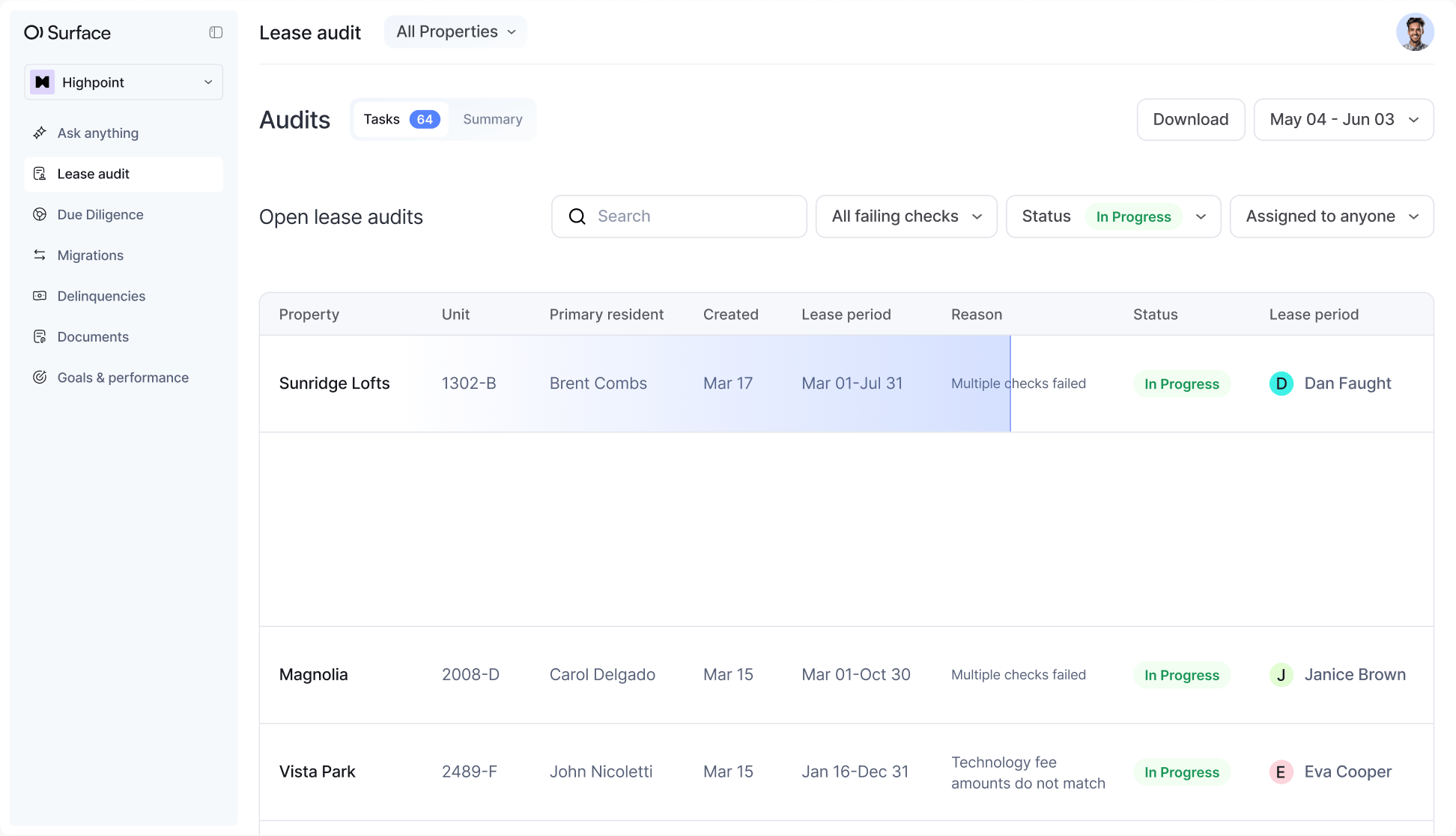
SurfaceAI is not a CRM. It complements CRM systems by helping multifamily investors and acquisitions teams validate the operational side of a transaction.
SurfaceAI helps teams:
- analyze lease documents at scale
- support AI lease due diligence
- identify revenue leakage
- validate rent roll assumptions
- improve acquisition confidence
- surface operational risks before closing
While a CRM tracks relationships and opportunities, SurfaceAI helps teams evaluate the underlying asset.
For diligence workflows, see how to evaluate AI lease due diligence platforms →
Teams that combine a strong CRM with operational intelligence tend to move faster from sourcing to closing. The CRM handles the relationship and pipeline view.
The operational intelligence layer handles the asset view. Pair that with structured diligence workflows. A hidden lease risk checklist and a clear method to prioritize lease due diligence findings help acquisition teams reduce surprises after closing.
Common Mistakes Investors Make When Selecting a CRM
Choosing an agent-focused CRM. Many platforms are optimized for residential sales workflows rather than acquisitions.
Prioritizing features over adoption. A simple real estate CRM that teams actually use often outperforms a complex system with poor adoption.
Ignoring reporting requirements. Executives need portfolio-level visibility, not just contact management.
Treating CRM as the entire technology stack. CRM systems manage relationships. They do not replace diligence, operational intelligence, or asset management systems.
Skipping real estate CRM reviews from peers. Generic software reviews often miss the workflow differences that matter most to investors.
What Investors Should Evaluate Before Choosing a CRM
When evaluating real estate CRMs, focus on:
Relationship management. Can the platform support broker, lender, and owner relationships?
Pipeline visibility. Can leadership see opportunities across the acquisition funnel?
Workflow automation. Can repetitive tasks be reduced?
Reporting. Can executives monitor performance effectively?
Scalability. Can the platform support future portfolio growth?
Customer service and support. Will the vendor help your team onboard and adopt the system?
Integration with the rest of the stack. Does the estate CRM software connect with your PMS, accounting, and diligence tools?
These criteria apply across markets. They work whether you are evaluating the best CRM for real estate Canada-based teams use, US-focused real estate CRMs, or global options. Real estate teams that take the time to evaluate against these criteria avoid the most common pitfall: choosing a CRM that looks great in a demo but does not match how the team actually works.
Key Takeaway
The best CRM for real estate investors is not necessarily the best CRM for agents or brokers.
Investors should prioritize systems that improve relationship management, deal visibility, workflow efficiency, and acquisition execution.
The strongest real estate technology stacks combine CRM systems with operational intelligence platforms. The intelligence layer validates the assets themselves.
Conclusion
CRM platforms play a critical role in sourcing opportunities, managing relationships, and supporting acquisitions workflows.
But successful investing depends on more than relationship management.
Teams also need confidence in the underlying asset data, lease quality, and operational performance.
If your acquisitions team wants stronger visibility into lease risk and portfolio intelligence, book a demo. SurfaceAI supports smarter multifamily investment decisions.
Frequently Asked Questions About CRM for Real Estate Investors