Property Migration: How to Transition Without Data Loss

Switching properties from one PMS to another is not simple. It is an operational transition that affects every layer of a real estate portfolio.
The quality of that transition determines how well lease data, financial records, resident information, and reporting workflows hold up.
Poor migration creates immediate impact. Data inconsistencies appear, documents go missing, and reporting becomes unreliable. In many cases, teams only discover these issues after operations have already resumed.
Institutional operators and growing portfolios must treat property migration as a controlled process. It is not a technical task. It is an operational risk event.
Why Migration Is More Than a Data Transfer
Most teams assume migration is about moving data from one system to another.
In reality, it involves aligning multiple layers of the operation:
- structured data such as rent rolls and ledgers
- unstructured data such as leases and resident documents
- system logic and workflows
- reporting structures across portfolios
The challenge is not just moving information. It is preserving meaning, relationships, and accuracy.
Real estate data does not follow the same standards as data in other industries. Real estate data from disconnected systems often contradicts itself. Verifying accuracy across legacy tools is a persistent challenge. CRE firms still navigate inconsistent, siloed data every day.
Accurate migration is a foundation-level problem. Commercial Observer documents why this challenge runs deeper than any single technology fix.
This is particularly important when multiple systems are already interacting. The limitations of traditional property management systems in multifamily real estate outline exactly where those interactions create risk.
Where Property Migration Typically Breaks Down
Migration failures rarely happen at the technical layer. They happen at the operational level.
Common failure points include:
- lease documents not properly linked to units
- incorrect mapping of rent charges and fees
- missing historical financial data
- inconsistent formatting across properties
- incomplete document transfers
These issues often go unnoticed during migration and surface only after reporting or billing cycles begin.
Migrating Properties from Another PMS Without Losing Data
A structured approach reduces risk significantly.
The process should be treated as a sequence of controlled stages:
1. Pre-Migration Audit
Before any data is moved, existing systems must be validated.
This includes:
- reviewing lease accuracy
- identifying missing documents
- verifying rent roll consistency
This step is often overlooked, but it determines the quality of everything that follows. It aligns closely with workflows used in real estate due diligence and data validation processes →
2. Data Mapping and Structuring
Every system stores data differently.
Field mapping must be precise, especially for:
- lease terms
- charges and concessions
- resident records
- financial structures
Without proper mapping, data may transfer successfully but still be incorrect. Integrating meaningfully with entrenched property management systems is harder than it appears.
3. Document Alignment
Unstructured data introduces the most risk during migration.
Documents must be:
- matched to the correct units
- linked to the correct residents
- categorized consistently
In most migrations, this step is still handled manually, which is where errors are introduced.
Teams miss assign lease files and miss addenda. Resident records become incomplete.
At scale, these issues compound quickly.
This is where automated document classification and validation becomes critical.
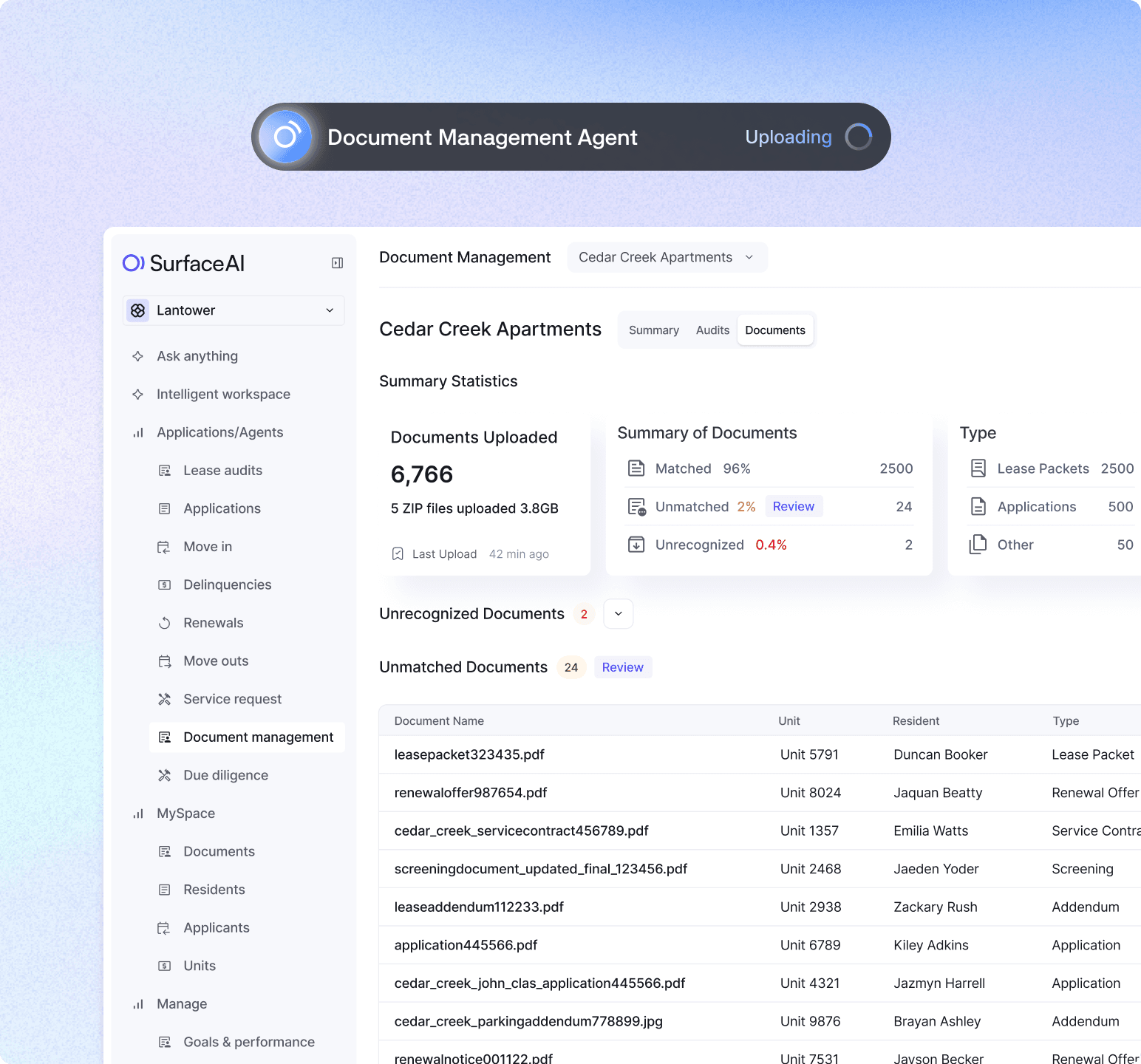
SurfaceAI’s document management layer is built specifically for this phase of migration. Instead of relying on manual sorting, documents are automatically:
- classified and organized
- matched to the correct units and residents
- validated against system data
This ensures that document integrity is preserved during migration, not reconstructed after the fact.
4. Controlled Migration
Data should be migrated in stages rather than all at once.
This allows teams to:
- identify issues early
- correct discrepancies
- validate smaller datasets
Large-scale migrations without checkpoints often compound errors.
5. Post-Migration Validation
Migration is not complete when data is transferred. Teams complete migration when they verify the data.
Validation should include:
- lease-level checks
- financial reconciliation
- document completeness
- cross-system consistency
Without validation, migration introduces silent errors into the system.
Choosing the Right Platforms for Migration
Some systems are better equipped to handle migration than others.
The best property management platforms for multi-location portfolio data migration typically offer:
- structured onboarding workflows
- flexible data mapping
- integration with existing systems
- support for large datasets
However, even the best platforms rely on the quality of incoming data.
Operators evaluating the best property management software for seamless onboarding and data migration should look beyond system features. The migration process itself matters just as much. Manual data entry during system transitions creates financial errors and compliance risks. These problems compound over time.
Structured data transitions lead to faster adoption and fewer errors. They also deliver stronger long-term ROI. Commercial Observer documents how firms that build transparent, integrated, and scalable data environments gain a measurable advantage over those relying on fragmented legacy workflows.”
The Role of Onboarding in Migration Success
Onboarding is where migration either succeeds or fails.
The best rental property management software onboarding data migration processes include:
- clear data requirements
- standardized templates
- guided migration workflows
- validation checkpoints
Some operators rely on providers offering seamless onboarding and data migration in property management companies.
This can accelerate the process. But providers who skip validation still expose operators to risk.
Why Document Workflows Matter During Migration
Documents are often the most fragile part of migration.
Unlike structured data, documents require:
- classification
- matching
- validation
Without structured workflows, this becomes inconsistent and error-prone.
This is why document handling connects directly to document workflow automation in real estate operations.
When teams automate and validate document workflows, migration becomes predictable. When they are manual, inconsistencies surface across the portfolio.
The Shift Toward Structured Migration Processes
Real estate operators are moving away from manual migration processes.
Instead, they are adopting:
- automated document workflows
- structured validation processes
- staged migration approaches
- continuous monitoring
This shift is driven by the need for accuracy at scale.
In large portfolios, even small inconsistencies can impact financial reporting and operational performance. The real story in real estate technology is not the tools. It is the processes that keep them accurate, compliant, and auditable.
Leasing activity, asset data, and portfolio performance have long lived in disconnected systems. Unifying them is now the defining challenge for the industry. Commercial Observer documents how leading platforms are building toward this connected model.
Where Data Validation Becomes Critical
Most migration strategies focus on moving data.
Fewer focus on validating it.
This is where modern approaches differ.
Operators are increasingly introducing validation layers that:
- detect inconsistencies in lease data
- flag missing or incorrect information
- ensure alignment between documents and system records
In complex portfolios, this becomes the difference between a clean transition and prolonged operational issues.
Key Takeaway
Property migration is not a technical task. It is an operational risk event.
Success depends on:
- auditing data before migration
- structuring workflows during migration
- validating outcomes after migration
Operators who approach migration as a controlled process maintain data integrity and operational continuity.
Those who treat it as a simple transfer often face delayed issues that are costly to resolve.
Frequently Asked Questions About Property Migration

Related content