
AI in Property Management: How Automation Is Redefining Operations
What Is AI in Property Management
AI in property management automates routine tasks, enhances tenant screening, and enables predictive maintenance, shifting the industry from reactive workflows to proactive oversight. Unlike traditional software that follows rigid if-then rules, AI-powered systems analyze patterns in lease data, resident communications, and financial records to make decisions and take action without constant manual input.
The distinction shows up in everyday operations. Traditional automation sends a rent reminder on day five of every month, regardless of context. An AI system, on the other hand, assesses a resident’s payment history, flags unusual patterns, and adjusts communication timing based on what it learns.
A few terms help clarify what’s happening under the hood:
- Machine learning: Algorithms that improve accuracy over time by processing more data, such as identifying which lease terms most often lead to disputes
- Natural language processing: The ability to read and extract meaning from unstructured text like lease PDFs, emails, and resident requests
- AI agents: Autonomous digital teammates that handle multi-step workflows continuously, not just responding to queries, but executing tasks in the background
The shift from chatbots that answer questions to agents that complete work represents the current frontier. When an AI agent monitors every lease change, flags missing charges, and assigns correction tasks to staff without human initiation, that’s a fundamentally different capability than a chatbot fielding maintenance requests.
Why Property Management Teams Are Turning to AI
Portfolios are growing while teams stay lean. Resident expectations for instant, digital-first communication have risen sharply. Meanwhile, the cost of manual processes – both in staff hours and in errors that slip through, continues to compound.
Most property management workflows remain reactive, 60% of property managers face monthly discrepancies. Lease audits happen after month-end close, when revenue has already been lost.
Maintenance gets scheduled after equipment fails. Delinquency follow-up depends on whether a site manager remembered to send the notice.
AI adoption among property managers grew from 21% to 34% in a single year. The pain points driving that adoption tend to cluster around a few recurring themes:
- Lease audit backlogs: Teams discover errors weeks or months after they occur, often too late to recover revenue
- Revenue leakage: Missing charges, incorrect rent amounts, and unsigned documents go unnoticed across large portfolios
- Compliance exposure: Out-of-policy concessions or incomplete documentation create liability that remains invisible until it surfaces as a problem
- Staff burnout: Repetitive administrative tasks consume time that could go toward resident relationships and leasing activity
According to the National Apartment Association, AI leasing assistants now operate 24/7 at many properties, providing instant responses to prospective renters via text and email. That same always-on capability is extending into back-office operations – lease audits, rent collection, and document management, where the stakes for accuracy are even higher.
How AI Integrates with Property Management Software
One of the most common concerns about AI adoption is whether it requires replacing existing systems. In most cases, it doesn’t. AI platforms typically layer on top of current property management software, connecting via APIs or cloud storage links to unify data from rent rolls, lease PDFs, and communication threads.
Teams can keep their PMS, their SharePoint folders, and their email workflows intact. The AI reads from those sources, analyzes the data, and either surfaces insights or takes action depending on how it’s configured.
| Integration Type | What It Does | Example |
|---|---|---|
| API connection | AI reads and writes directly to PMS | Sync lease data in real time as changes occur |
| Cloud storage link | AI ingests documents from existing drives | Scan lease PDFs stored in OneDrive or SharePoint |
| Email parsing | AI extracts data from communication threads | Pull resident requests and payment confirmations from inbox |
The practical benefit is speed to value. Rather than a multi-month implementation that disrupts operations, AI tools can often begin analyzing existing data within days. SurfaceAI’s platform, for instance, connects to core systems and cloud storage to unify data from every corner of operations – whether it’s a rent roll, a lease PDF, or an email thread.
Why Property Management Needs AI
Managing real estate portfolios has grown increasingly complex, multiple properties, dozens of lease versions, tenant inquiries, and compliance rules. Traditional property management software centralizes data, but it doesn’t always act on it.
That’s where AI in property management comes in. By embedding intelligence and automation into existing systems, AI turns static software into an active problem-solver.
AI property management software enables:
-
Continuous lease and rent audits.
-
Smart communication through chatbots and digital assistants.
-
Predictive insights for tenant behavior and revenue trends.
-
Automated follow-ups on payments and maintenance.
(Reference: Propmodo – How AI Is Modernizing Property Management →)
AI Tools for Property Management Operations
The most impactful AI applications in property management tend to focus on workflows where manual processes break down at scale. While leasing chatbots get significant attention, the operational gains often come from less visible functions: audits, collections, due diligence, and document management.
Lease Audit Automation
Traditional lease audits are periodic – quarterly reviews, month-end spot checks, or annual compliance sweeps. The problem is that errors don’t wait for audit cycles. A missing pet fee or an unsigned addendum can persist for months before anyone notices.
Continuous lease audit automation changes that dynamic. AI monitors every lease change as it happens, syncing data from the PMS, triggering audits on new or updated leases, and flagging issues like missing charges, unsigned documents, or out-of-policy concessions. When something’s wrong, the system assigns a task to the appropriate staff member.
SurfaceAI’s Lease Audit Agent operates on this model – running 24/7 to catch errors and revenue leaks the moment they appear, rather than waiting for a scheduled review.
Delinquency Workflow Management
Rent collection is one of the most operationally fragile workflows in multifamily. Inconsistent follow-up, missed notices, and undocumented communications create both revenue risk and compliance exposure.
AI-powered delinquency management automates the sequence from first notice to escalation, ensuring every resident receives timely, consistent communication according to predefined rules. The system logs every touchpoint, creating an audit trail that protects operators in the event of disputes.
Due Diligence and Acquisition Support
Pre-acquisition analysis traditionally involves weeks of manual lease file review. Analysts comb through rent rolls, cross-reference lease terms, and try to identify red flags before closing.
AI compresses that timeline dramatically. Due diligence agents can ingest hundreds of lease PDFs, extract key terms, and flag mismatches – names that don’t align, rent amounts that differ from the roll, unsigned documents, or residents with concerning payment histories. What once took days can happen in hours.
Document Management During Property Transitions
Property takeovers generate document chaos. Lease files arrive in inconsistent formats, often incomplete, and someone has to classify each document, match it to the correct resident, and upload it to the new PMS.
Document management AI automates that entire workflow. It scans folders for completeness, classifies each file by type, matches documents to leases, and syncs them into the PMS with full mapping. The result is properties that are ready for operations without weeks of manual cleanup.
AI Assistants for Portfolio Questions and Oversight
Generic AI tools can answer general questions, but they don’t know your policies, your leases, or your portfolio. Property management AI assistants trained on company-specific data provide fast, contextual answers grounded in actual documents.
A regional manager can ask “What’s the pet policy at Oakwood Apartments?” and get an accurate answer pulled directly from that property’s lease documents, not a generic response. SurfaceAI’s Ask Anything feature works this way – securely trained on your data, with permission-aware access from any page in the platform.
How AI Benefits Property Management Teams
The benefits of AI in property management extend beyond efficiency gains. McKinsey has observed over 10 percent gains in NOI from AI-driven operating models in real estate, and revenue, compliance, and decision-making improve in ways that compound over time.
Revenue Recovery and NOI Protection
Continuous monitoring catches revenue leakage before month-end close. Across a portfolio, even small per-unit errors add up quickly.
- Missing recurring charges – pet fees, parking, storage – get identified and corrected before they become write-offs
- Incorrect rent amounts flagged at lease signing prevent months of under-collection
- Unsigned documents surface before they create liability or complicate renewals
Compliance Risk Reduction
AI enforces policy adherence automatically, removing the variability that comes with manual oversight.
- Out-of-policy concessions get flagged immediately, before they set precedents
- Incomplete documentation is tracked and assigned for resolution
- Every lease change generates an audit trail, creating defensible records
Operational Efficiency and Staff Productivity
When AI handles repetitive tasks, staff time shifts to higher-value work. Automated delinquency notices reduce manual follow-up significantly. Document uploads during transitions complete without dedicated staff time. Lease audits run continuously without spreadsheet reviews or calendar reminders.
Faster Decision-Making Across Portfolios
Unified data and AI-generated insights give asset managers and corporate teams real-time visibility into performance across properties. Instead of waiting for monthly reports, they can see which sites need attention today.
How AI Agents Work Alongside Property Managers
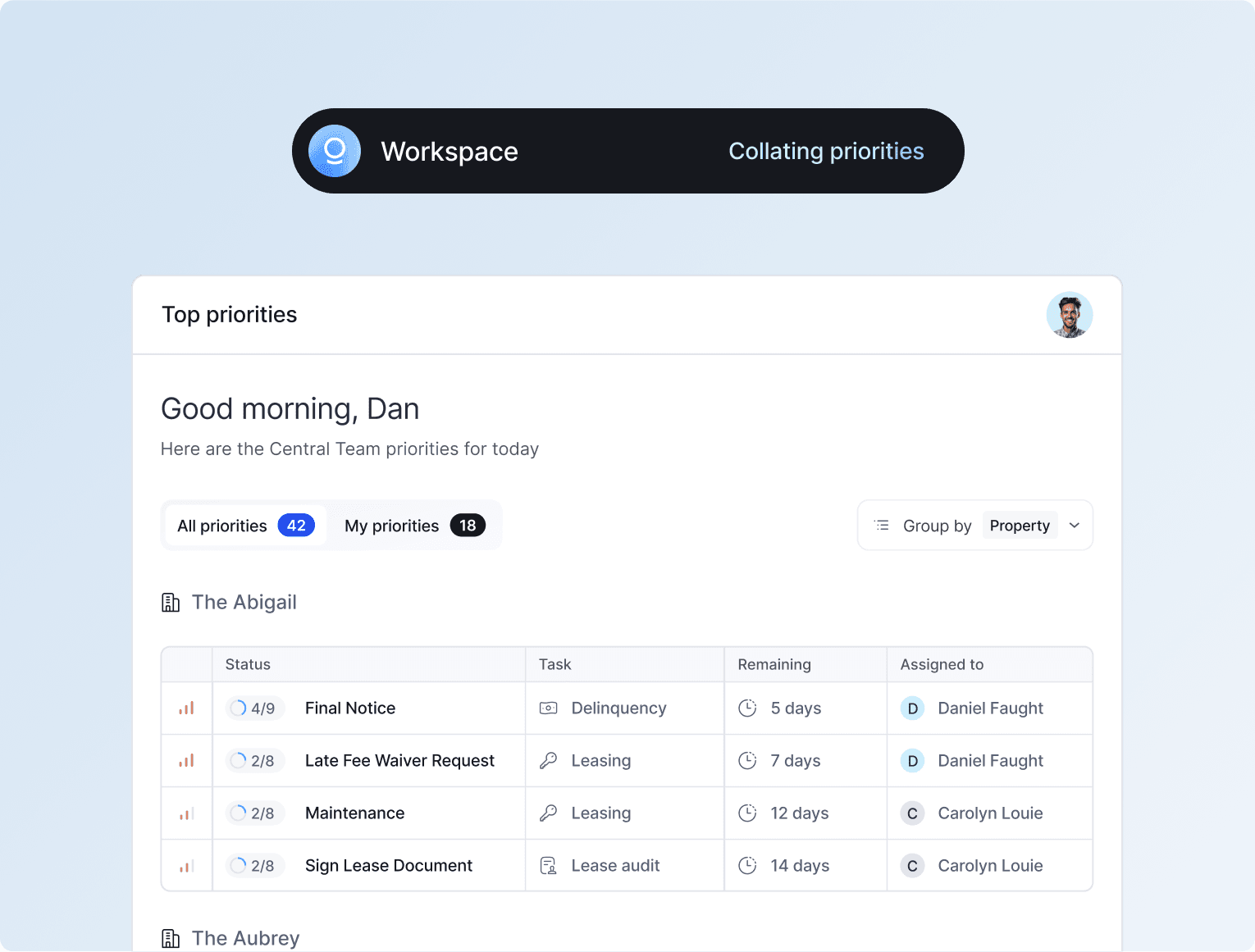
The human-AI collaboration model matters more than the technology itself. AI agents operate in the background – monitoring data, flagging anomalies, assigning tasks – while property managers retain decision authority over resident relationships, exceptions, and escalations.
This isn’t about replacing staff. It’s about removing the administrative burden that prevents staff from doing their best work. When a leasing agent doesn’t have to spend two hours reconciling a spreadsheet, that time can go toward tours, follow-ups, and resident engagement.
SurfaceAI’s philosophy captures this distinction: AI agents act, not just chat. The goal is intelligent teammates that complete real work, not another tool that requires constant supervision.
How SurfaceAI Works with Property Management Software
SurfaceAI isn’t another property management platform. It’s the intelligence layer that connects with your PMS, CRM, and communication tools to automate high-value workflows.
| SurfaceAI Agent | Role | Key Benefit |
|---|---|---|
| Lease Audit Agent | Reviews every lease for missing charges, incorrect terms, or compliance issues. | Protects NOI and reduces human review time. |
| Due Diligence Agent | Analyzes large lease portfolios during acquisitions. | Accelerates transactions and uncovers risk. |
| Delinquency Agent | Tracks rent payments and automates follow-ups. | Prevents revenue loss and streamlines collections. |
Each agent integrates seamlessly with property management software, ensuring automation happens inside existing workflows.
See how automation scales in Property Management Workflow Automation →
Benefits of AI-Powered Property Management
-
Efficiency: eliminate repetitive data entry and manual reviews.
-
Accuracy: reduce human error in billing and lease compliance.
-
24/7 Service: AI assistants manage inquiries round-the-clock.
-
Scalability: handle more units without adding headcount.
-
Revenue Protection: automatically detect missed fees or rent issues.
Learn how these efficiencies connect to the bigger ecosystem in Real Estate AI →
Read about related trends in Tech in Property Management →
Integrating SurfaceAI with Your Property Management System
Implementation is straightforward:
-
Connect SurfaceAI to your PMS (e.g., Yardi, RealPage, Entrata).
-
Enable agents to start auditing, tracking, and automating tasks.
-
Monitor through Workspace, where teams can review flagged issues and performance metrics.
No need to replace existing systems, SurfaceAI adds automation on top of them.

“So much more effective to find issues rather than us dig dig dig - all in one document. The convenience is great”
Ally Goeller
The Future of AI-Powered Property Management
The trajectory is clear: AI is moving from single-task tools toward integrated operating systems for property management. Agentic AI – systems that manage complex, multi-step workflows independently – represents the next phase.
Rather than separate tools for lease audits, delinquency, and due diligence, operators will increasingly work within unified platforms where AI agents coordinate across functions.
To see how AI agents can transform your property operations, book a demo.
Frequently Asked Questions about AI in Property Management