
Transform Real Estate Operations with SurfaceAI

Real estate software has evolved far beyond digital filing cabinets. The platforms that once simply stored lease records and tracked rent payments now actively monitor operations, flag problems before they escalate, and execute workflows autonomously in the background.
For multifamily operators managing distributed portfolios, this shift matters. Fragmented data across property management systems, rent rolls, and lease PDFs creates real business risk, missed charges, compliance gaps, and manual processes that drain NOI. This piece covers what modern real estate software does, how AI agents differ from traditional tools, which workflows to prioritize for automation, and how to evaluate vendors.
Why Multifamily Operations Need Modern Real Estate Software
Top real estate software companies – Yardi, RealPage, MRI Software – have long provided comprehensive property management and investment solutions. Yet the landscape is shifting, AI adoption surged from 21% to 34% in a single year. Operators no longer just want a system of record. With NOI growth at just 1% year-over-year, they want software that actively protects revenue, flags problems in real time, and reduces the manual work that drains onsite teams.
Managing a distributed portfolio means dealing with data scattered across property management systems, rent rolls, lease PDFs, and email threads.
This fragmentation creates real business risk:
Missed charges slip through, unsigned documents go unnoticed, and out-of-policy concessions get approved without oversight.
The National Apartment Association estimates that the average multifamily property loses 2-4% of potential revenue annually to billing errors and missed charges. For a 500-unit portfolio at $1,500 average rent, that translates to $180,000-$360,000 in preventable leakage each year.
Modern real estate software acts as an operational layer that unifies data and enables proactive oversight. Rather than waiting for month-end reconciliation to discover problems, real-time financial monitoring surfaces issues while there’s still time to fix them.
What Real Estate Software Programs Do for Property Operations
Real estate software programs centralize and automate core property management functions. The category has evolved significantly over the past decade, moving from basic accounting tools to comprehensive operational systems that touch every aspect of portfolio management.
Property and Lease Management
Lease tracking, tenant records, renewals, and document storage form the foundation of any real estate software platform. Traditional tools store this information passively, you can look up a lease, but the system won’t tell you if something’s wrong with it.
Modern platforms take a different approach. They actively monitor lease data, flagging missing signatures, expired documents, or terms that fall outside policy parameters. The difference is reactive storage versus proactive oversight.
Financial Reporting and Accounting
Rent collection, expense tracking, owner statements, and audit trails form the financial backbone of any real estate software solution. Accurate data here directly impacts NOI, a CRETI study found 60% of property managers encounter monthly financial discrepancies, and inaccurate data can take months to untangle.
The best platforms connect financial data to operational workflows. When a resident’s payment fails, the system doesn’t just record it – it triggers the appropriate follow-up sequence automatically.
Resident Services and Communication
Online payments, maintenance requests, and automated notices improve both operational efficiency and resident satisfaction. What separates leading solutions is consistency: every resident receives the same communication cadence, the same payment options, and the same service experience, regardless of which property they live in or which staff member happens to be on duty.
Portfolio Analytics and Visibility
Dashboards provide visibility into occupancy, delinquency, and performance trends across properties. Asset managers and regional leaders rely on this data to make informed decisions quickly.
| Traditional PMS Functions | AI-Enhanced Real Estate Software Solutions |
|---|---|
| Manual lease audits | Continuous automated auditing |
| Periodic compliance checks | Real-time policy monitoring |
| Reactive delinquency follow-up | Automated collection workflows |
| Spreadsheet-based reporting | Live portfolio dashboards |
How AI Agents Deliver Smarter Realty Software Solutions
AI agents represent a fundamental shift in how real estate software operates. They are autonomous systems that execute operational tasks in the background, 24/7, not chatbots that answer questions and wait for humans to act.
AI That Acts vs. AI That Chats
Generic conversational AI responds to queries but requires human action to accomplish anything. You ask a question, you get an answer, and then you still have to do the work yourself.
Task-oriented agents operate differently. They execute workflows autonomously: assigning tasks to staff, flagging errors for review, syncing data between systems. The distinction matters because it determines whether AI reduces your workload or simply adds another interface to manage.
- AI agents: Execute tasks autonomously in the background
- Chatbots: Respond to queries but require human action to follow through
Continuous Monitoring vs. Periodic Audits
Most operators audit leases quarterly, if that. The problem? Issues that occur in January don’t get caught until April, and by then, you’ve lost three months of revenue or accumulated three months of compliance exposure.
Continuous monitoring flips this model.
- Each lease change triggers an immediate review.
- Every new document gets checked against policy.
- Charges are validated against the lease terms in real time.
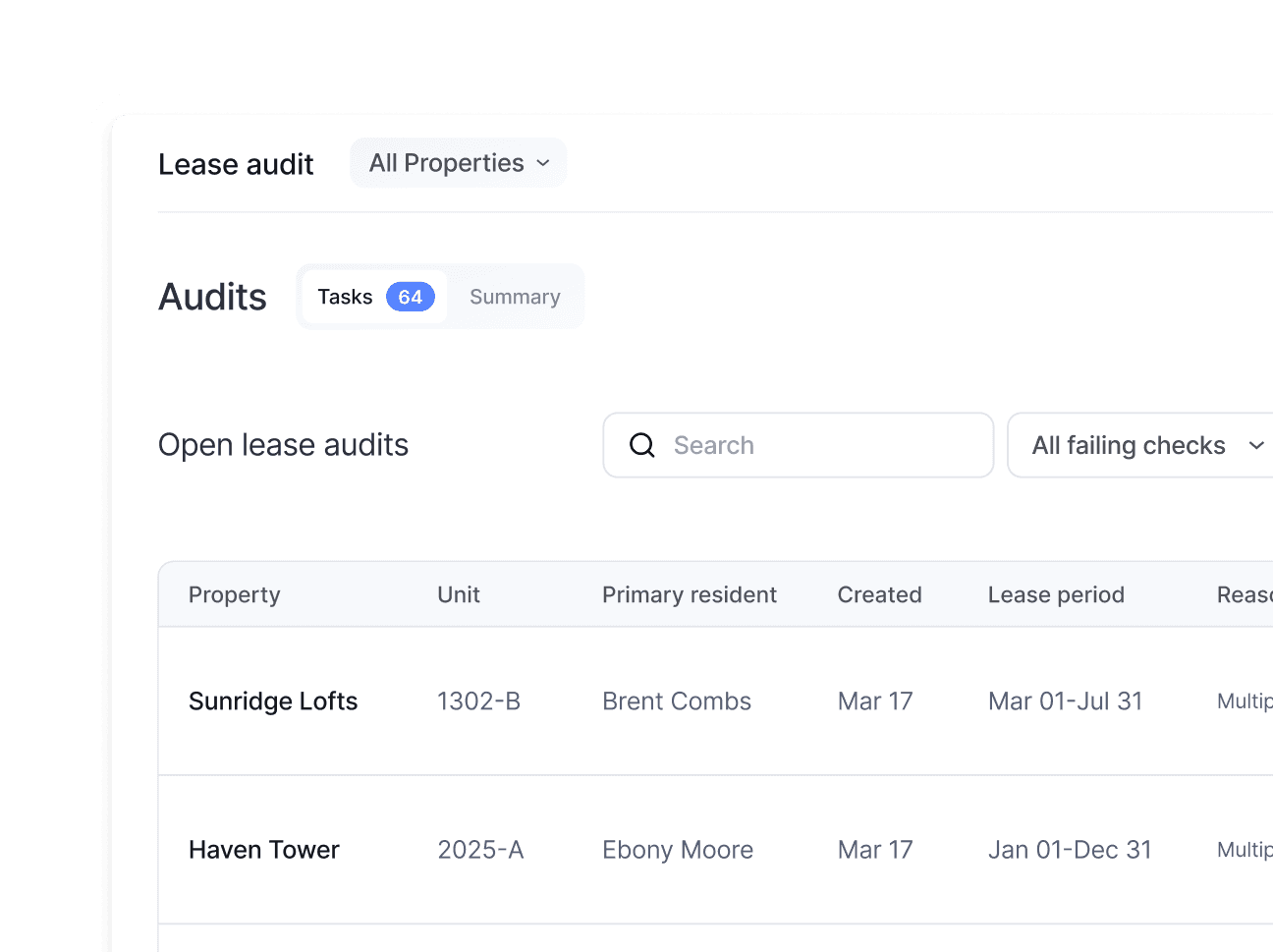
SurfaceAI’s Lease Audit Agent, for example, runs 24/7 to catch errors the moment they appear.
Automated Workflows vs. Manual Processes
Consider delinquency management. In a manual process, staff track who’s late, decide when to send notices, and follow up individually. Execution varies by property, by staff member, by day of the week.
Automated workflows standardize this entirely. When rent isn’t received, the system triggers the appropriate notice sequence based on predefined rules, accounting for state regulations, resident history, and property-specific policies. Every resident receives consistent, compliant communication without manual chasing.
Key Workflows Real Estate Software Solutions Automate
Modern real estate software solutions target high-impact, error-prone workflows where automation delivers measurable ROI.
Lease Auditing and Compliance Monitoring
Continuous lease auditing involves reviewing every lease for missing charges, unsigned documents, and policy violations – automatically. When the system identifies an issue, it assigns a task to the appropriate staff member with clear instructions for resolution.
This approach eliminates the audit backlog that plagues most portfolios. Instead of discovering six months of problems during a quarterly review, teams address issues within days of occurrence.

Due Diligence for Acquisitions and Transitions
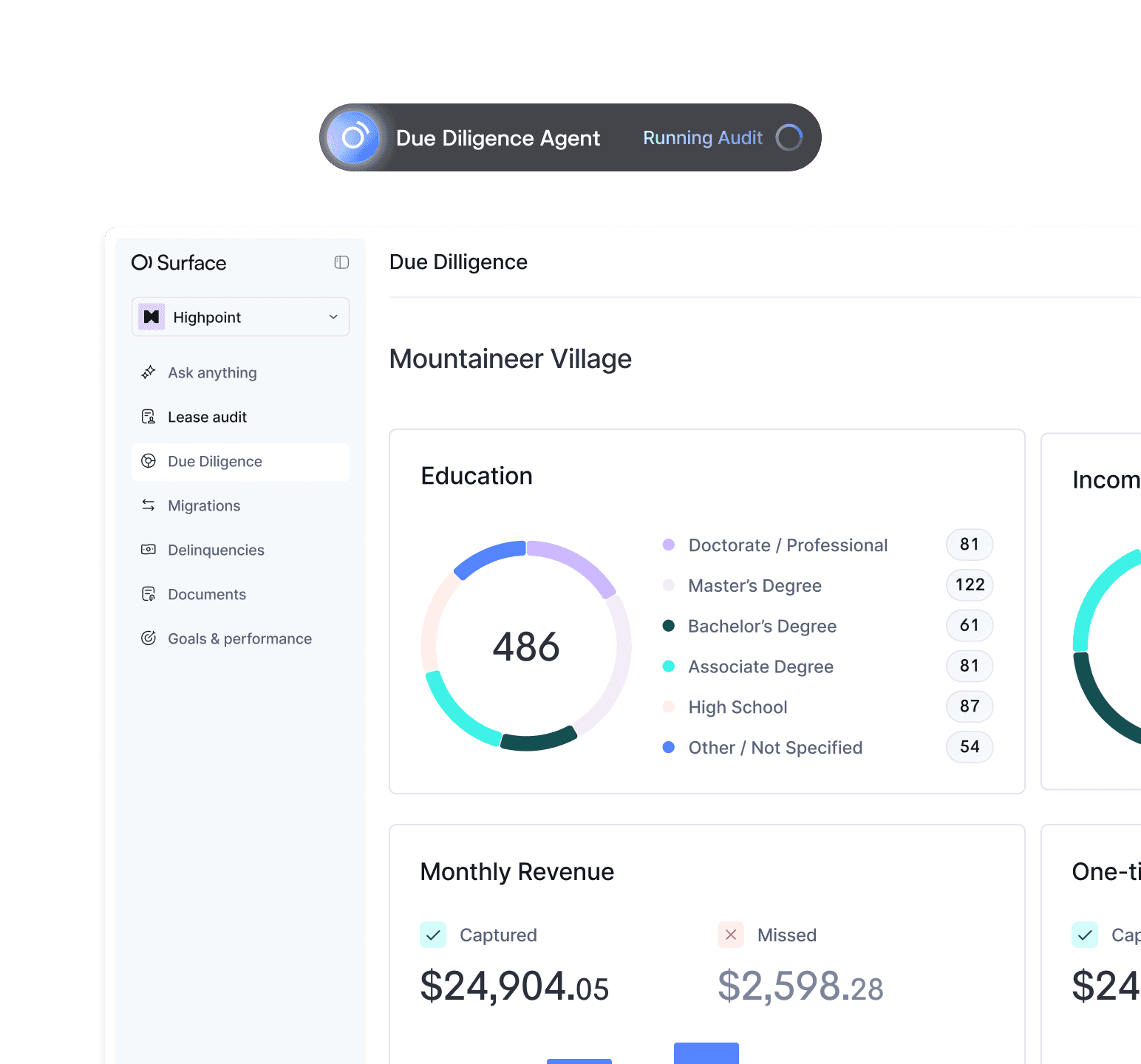
Property acquisitions require reviewing hundreds or thousands of lease files to assess resident quality, revenue integrity, and risk exposure. Manually, this process takes weeks and still misses critical details.
Automated due diligence extracts and analyzes resident data, rent rolls, and lease PDFs in hours. The system highlights red flags – mismatched terms, delinquency patterns, occupancy anomalies – so acquisition teams can make informed decisions faster.
Delinquency and Rent Collection Workflows
Automated delinquency management ensures consistent, compliant communication from first notice to final follow-up. The system tracks every interaction, timestamps every notice, and escalates appropriately based on resident response.
- First notice: Triggered automatically when payment is missed
- Follow-up sequence: Escalates based on predefined rules and resident history
- Documentation: Every communication logged for compliance and audit purposes
Document Management and PMS Migration
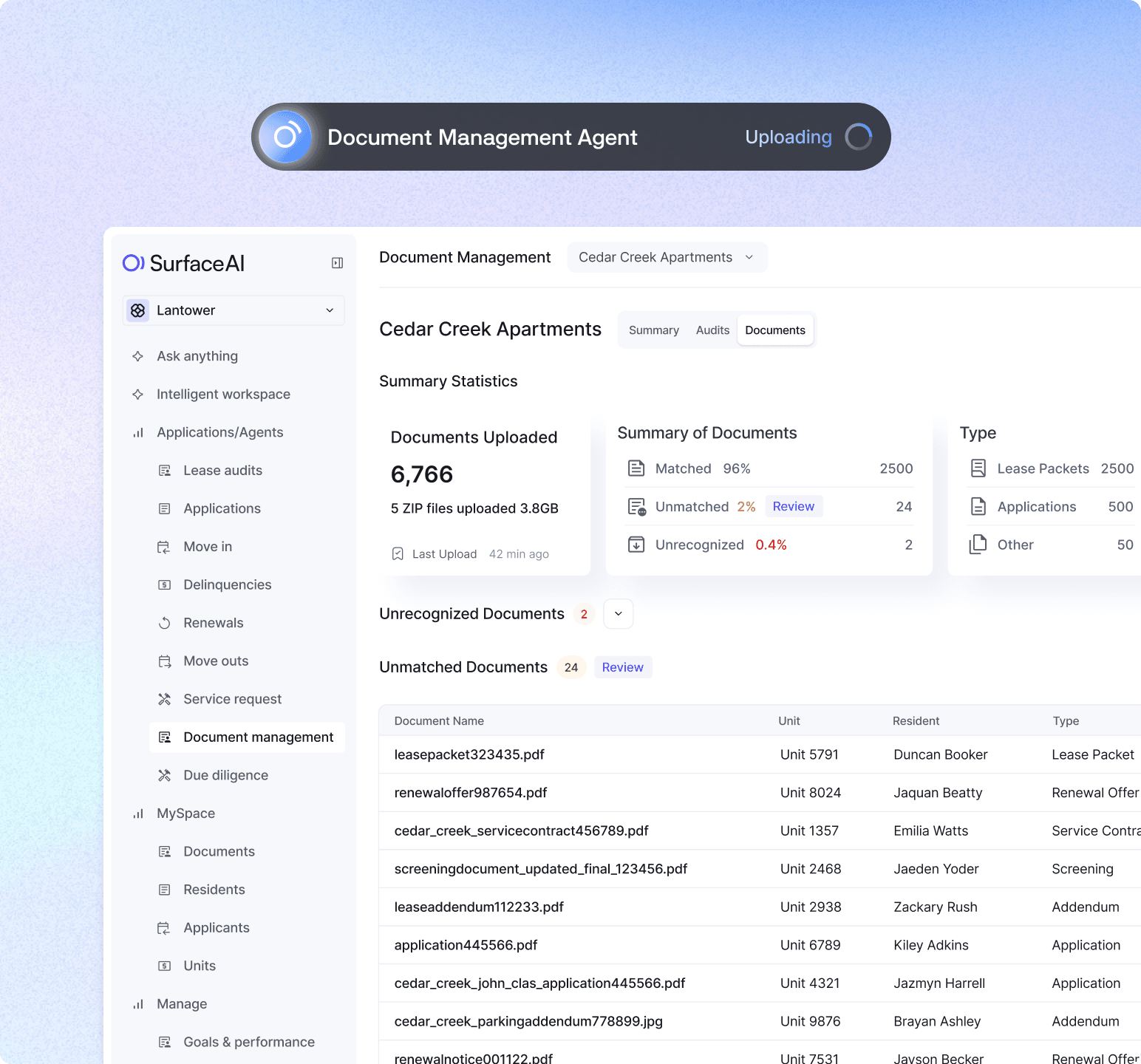
Property transitions often create document backlogs that take weeks to resolve. Staff manually review rent rolls, classify documents, match files to residents, and upload everything to the new PMS.
Automated document management compresses this timeline dramatically. The system ingests document folders, classifies each file, matches documents to the correct lease and resident, and syncs everything to the PMS with full mapping and exception reporting.
How Real Estate Software Integrates with Existing Systems
Leading real estate software companies design their platforms to connect with the systems operators already use. This includes property management systems like Yardi, RealPage, and AppFolio, as well as cloud storage tools like OneDrive and SharePoint.
Integration enables a unified data layer without requiring operators to replace existing tools. Rent rolls, lease PDFs, email threads, and PMS records all feed into a single operational view.
SurfaceAI’s approach exemplifies this model: the platform sits on top of core systems as an operational intelligence layer, pulling data from every corner of operations and making it actionable through AI agents and a centralized Workspace hub.
Who Benefits from Real Estate Software Solutions
Different roles within a multifamily organization derive different value from real estate software.
Onsite Property Management Teams
Site teams benefit from reduced administrative burden and faster issue resolution. Instead of hunting through spreadsheets for problems, they receive clear task assignments with specific instructions. Real-time visibility into daily operations means fewer surprises and more time for resident-facing work.
Corporate and Regional Operations Leaders
Regional and corporate teams gain standardized workflows and compliance oversight across the portfolio. Dashboards surface which properties need attention, which issues are trending, and which sites are falling behind on key metrics.
Asset Managers and Acquisition Teams
Asset managers and acquisition teams value faster due diligence, early risk detection, and confidence in revenue integrity. The ability to assess a property’s true operational health, before closing, can prevent costly surprises and inform better investment decisions.
How to Evaluate Real Estate Software Companies
Selecting the right real estate software requires a structured evaluation process.
1. Assess Workflow-Specific Automation Capabilities
Does the platform automate your highest-priority workflows – lease audits, delinquency, due diligence – or does it only offer generic features? Specificity matters. A platform that claims to “do everything” often does nothing particularly well.
2. Verify Integration with Your PMS and Data Sources
Confirm compatibility with your existing property management system and document storage tools. Ask for specific examples of integrations with your exact tech stack, not just a list of supported platforms.
3. Compare AI-Native vs. Bolt-On Approaches
Some platforms build AI into the core product from day one. Others add AI features as an afterthought, bolting them onto legacy architecture. The difference shows up in performance, reliability, and depth of automation.
4. Calculate ROI and Time to Value
How quickly does the platform deliver measurable operational improvements? The best vendors can point to specific metrics: faster audits, fewer errors, recovered revenue. Ask for case studies with concrete numbers.
Unlock Smarter Operations with SurfaceAI
SurfaceAI is an AI agent platform purpose-built for multifamily operations. The platform’s key differentiators include 24/7 agents that act autonomously, continuous oversight that never stops, and a unified Workspace hub where teams monitor operations, flag issues, and take action across the portfolio.
Unlike traditional property management software that stores data passively, SurfaceAI’s agents work in the background, auditing leases, managing delinquency workflows, accelerating due diligence, and migrating documents, so teams can focus on the priorities that move the business.
FAQs about Real Estate Software Companies

Related content