
How Real Estate Due Diligence Actually Works at Scale

Real estate due diligence is one of the most critical phases in any acquisition. A process that determines whether an investment performs as expected or carries hidden risks that impact long-term returns.
For institutional real estate firms and multifamily operators, DD real estate or due diligence is not just a checklist. It is a structured, multi-layered process that combines financial analysis, lease validation, operational review, and risk assessment.
While many discussions focus on tools or software, the reality is that due diligence success depends on how the process is executed.
For a broader perspective on how this process is evolving, see Rethinking Due Diligence: Why Multifamily Acquisitions Need Automated Intelligence
What Real Estate Due Diligence Actually Involves
At a high level, real estate due diligence answers one question:
Does the asset match the financial and operational assumptions behind the deal?
To answer that, teams analyze multiple components:
- lease agreements and rent rolls
- financial statements
- operating expenses
- tenant and occupancy data
- maintenance and capital requirements
- legal and compliance documentation
Each of these areas carries risk. The purpose of due diligence is to identify those risks before closing. Acquiring the wrong asset is costly.
Bisnow reports that 60% of dry powder in the country is now targeting multifamily assets. That level of competition makes thorough diligence more important than ever.

The Real Estate Due Diligence Process (Step-by-Step)
Institutional real estate firms typically follow a structured process.
1. Data Collection
The first stage involves gathering all relevant documents:
- lease files
- rent rolls
- trailing financials
- service contracts
- tenant records
- compliance documents
In many acquisitions, this data comes from multiple sources and formats. The biggest challenge at this stage is inconsistency.
Data fragmentation is one of the biggest challenges in real estate. Commercial Observer documents how AI tools are now aggregating data from multiple sources and structuring it for faster decision-making.
2. Lease and Rent Roll Validation
One of the most critical steps is verifying that lease data matches financial records.
This includes:
- base rent accuracy
- concessions
- fees and charges
- lease start and end dates
- renewal terms.
Errors in lease data directly impact revenue projections. Even minor miscalculations can have major financial consequences. Commercial Observer notes that AI mitigates these risks by analyzing data at a scale and precision that humans cannot match.
For a deeper look at how lease analysis is evolving, see AI Lease Agreements →
3. Financial Analysis
Teams evaluate the financial performance of the asset:
- net operating income (NOI)
- expense ratios
- historical trends
- variance between reported and actual performance
The goal is to validate whether the asset is performing as represented. Inaccurate financials during diligence have real consequences after closing. GlobeSt. documents how acquisition teams that rely on incomplete data during diligence often hand off properties that cannot meet the proforma.
4. Operational Review
Beyond financials, teams assess how the property is being operated. This includes:
- leasing practices
- delinquency management
- maintenance workflows
- vendor relationships
Operational inefficiencies often indicate future performance risks. The Real Deal documents how AI now extracts key lease terms, flags missing clauses, and centralizes financial data automatically during underwriting. This shifts analyst time from data gathering to interpretation.
5. Risk Identification
At this stage, findings are consolidated to identify risks such as:
- revenue leakage
- compliance gaps
- incomplete documentation
- inconsistent lease execution
- underreported expenses
These risks influence pricing, deal structure, or whether to proceed. Missing this step is expensive. GlobeSt. documents how adequate diligence upfront helps avoid retrades from buyers negotiating aggressively because they know the seller just wants to close.
6. Final Due Diligence Report
All findings are summarized into a report used by:
- investment committees
- asset managers
- lenders
- stakeholders
Real estate due diligence report review at this stage determines the final decision on the deal.
Why Traditional Due Diligence Breaks at Scale
The traditional due diligence model is heavily manual. Teams rely on:
- spreadsheets
- document reviews
- sampling methods
- manual reconciliation
This creates several challenges:
- limited coverage (not all leases reviewed)
- human error
- time constraints
- inconsistent analysis across deals
For large multifamily portfolios, this becomes a serious limitation. Even small errors can scale across hundreds or thousands of units.
The Real Deal reports that underwriting a single deal may still require toggling between spreadsheets, PDFs, emails, and multiple platforms. Even when AI accelerates one component, the overall workflow can remain slow.
The Role of Due Diligence Software
Due diligence software was introduced to improve efficiency. The best due diligence software helps teams:
- organize documents
- centralize data
- standardize workflows
- track progress across teams
However, most software still depends on manual validation. It improves process coordination, but not necessarily data accuracy.
Commercial Observer notes that just throwing PDFs into a generic AI tool does not cut it. Real estate documents require domain-specific structure before AI can deliver reliable output.
For more on this, see Financial Due Diligence Software →
AI in Real Estate Due Diligence
AI is now being introduced to address the limitations of manual processes.
The same principles driving artificial intelligence for M&A due diligence are now being applied to real estate acquisitions. Modern due diligence data analytics software goes beyond organization. It can:
- analyze large volumes of lease documents
- compare lease terms with rent roll data
- detect discrepancies automatically
- identify missing or inconsistent information
- flag anomalies across portfolios.
This allows teams to move from:
sampling → full coverage
Instead of reviewing a subset of leases, AI systems can evaluate entire portfolios. AI-powered lease abstraction accuracy has reached enterprise-grade levels. Commercial Observer documents how hybrid AI and human review has pushed annotation accuracy to 99%.
For a broader overview, see AI Due Diligence →
Automated Deal Due Diligence
Automation is changing how deals are evaluated. Many firms are borrowing from M&A due diligence software workflows, applying:
- faster analysis timelines
- more consistent review processes
- improved accuracy across large datasets
- earlier identification of issues
This is particularly important in competitive acquisition environments where speed matters. Firms that can complete diligence faster without sacrificing accuracy gain a significant advantage. Commercial Observer reports that AI-powered diligence platforms can condense weeks of research into hours.
The Due Diligence Checklist. What Actually Matters
While many due diligence checklists exist, the most important areas consistently include:
1. Lease Accuracy
- Are lease terms correctly reflected in the system?
- Are concessions applied properly?
2. Revenue Validation
- Do rent rolls match executed leases?
- Are all fees accounted for?
3. Expense Accuracy
- Are operating expenses correctly categorized?
- Are there hidden or inconsistent costs?
4. Documentation Completeness
- Are all lease documents present?
- Are amendments and addenda included?
5. Operational Consistency
- Are leasing practices standardized?
- Are policies applied consistently across units?
A checklist alone is not enough. Execution is what determines outcomes. Thesis Driven documents how AI agents now handle document processing, lease abstraction, and risk flagging end to end. That shifts the checklist from a manual exercise to an automated one.
Where SurfaceAI Fits in Due Diligence
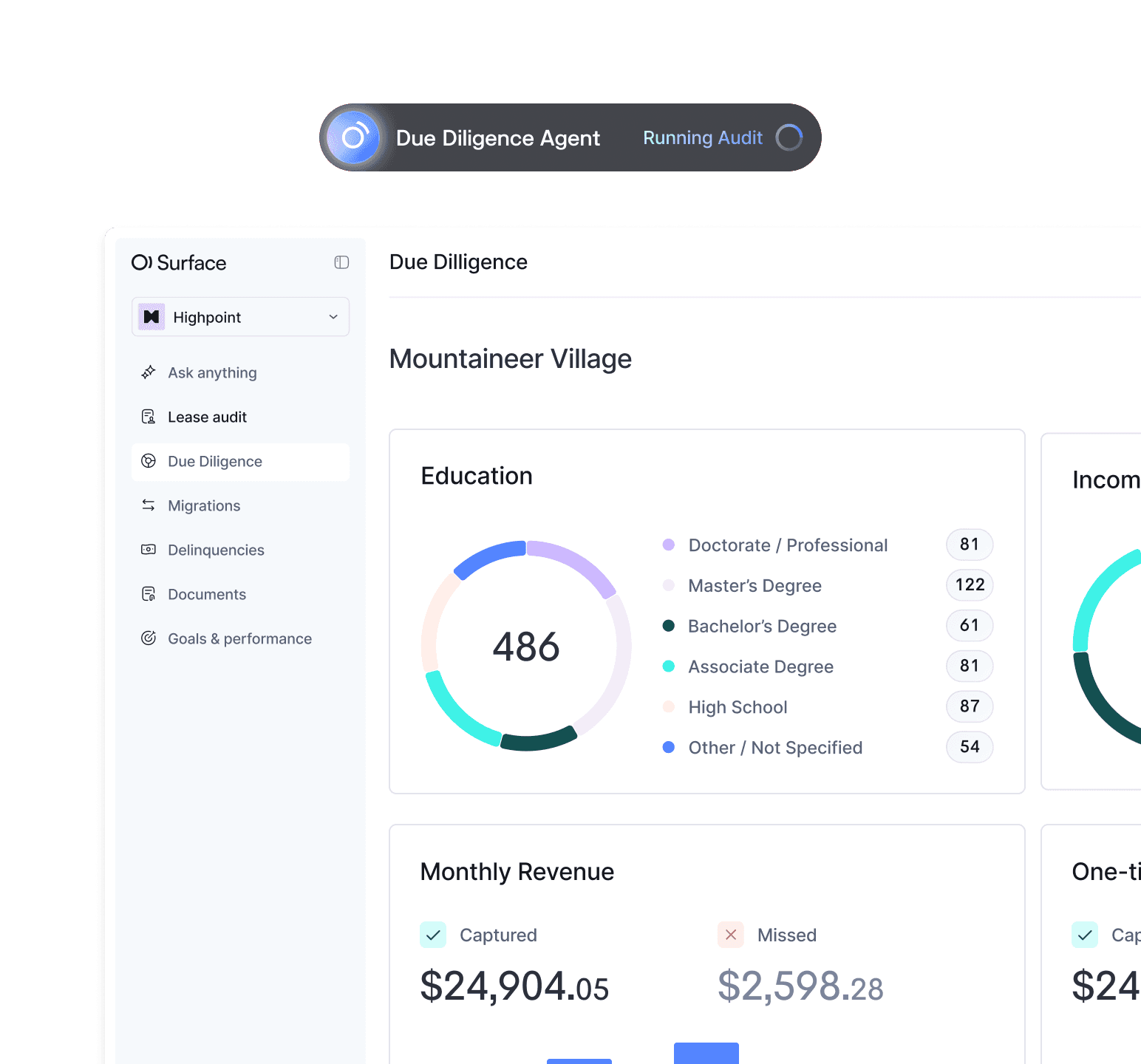
SurfaceAI operates as an intelligence layer within the due diligence process. For teams evaluating real estate due diligence services, it does not replace the process itself. But enhances it.
SurfaceAI supports due diligence teams by:
- analyzing lease documents at scale
- reconciling lease data with rent roll and financial records
- identifying discrepancies across portfolios
- surfacing revenue leakage
- improving confidence in acquisition data
This allows teams to:
reduce manual review time
increase coverage across leases
improve accuracy of findings
make faster, more informed decisions.
Commercial Observer identifies SurfaceAI as using computer vision to read leases, rent rolls, and financial statements. It identify revenue leakage and underwriting gaps across multifamily portfolios.
For a system-level perspective, see Real Estate Due Diligence Software →

“The worst part of due diligence is doing the audits and SurfaceAI has taken that on”
Gary Robbins, Transitions Manager
Building a Modern Due Diligence Stack
Institutional real estate firms are moving toward layered due diligence stacks:
Document management systems Used for storing and organizing files.
Due diligence platforms Used for workflow coordination and tracking.
Financial analysis tools Used for modeling and forecasting.
AI intelligence layers Used for validation, anomaly detection, and data reconciliation.
This layered approach improves both speed and accuracy. The Real Deal documents how firms rethinking execution end to end and not just automating one step. And they are gaining the greatest strategic advantage.
Key Takeaway
Real estate due diligence is no longer just a checklist. It is a structured process that combines data collection, financial validation, lease analysis, operational review, and risk identification.
As portfolios grow and transactions become more complex, manual processes are no longer sufficient. Modern due diligence relies on a combination of structured workflows and intelligent systems.
AI platforms like SurfaceAI enable teams to analyze more data, identify risks earlier, and make better investment decisions.
See it in action and Book a Demo →
Frequently Asked Questions About How Real Estate Due Diligence Actually Works at Scale

Related content