
Real Estate Document Management Software for Multifamily Portfolios

In multifamily real estate, documents are the operational backbone of every property.
- Lease agreements
- Addenda
- Disclosures
- Resident notices
- Vendor contracts
- Loan documentation
- Compliance records
- Due diligence files
all flow through document systems continuously, and the volume compounds quickly at scale.
A 5,000-unit portfolio can generate many lease files, thousands of renewals, and multiple amendment versions. It can also create diligence files for acquisitions and reporting packages for lenders.
Traditional document storage systems does not account for that complexity in their design. Modern real estate operators are using document management software and AI assistants more often. These tools automate document work, cut compliance risk, and improve portfolio visibility.
What Is Real Estate Document Management?
Real estate document management is a system that stores, organize, retrieve, and process property-related documents across a portfolio. These systems handle lease agreements, lease addenda, resident notices, vendor contracts, compliance documentation, loan and financing documents, and acquisition diligence files.
Historically, teams stored these documents in shared drives, property-level folders, email attachments, and manual filing systems. As portfolios grow, this approach becomes unmanageable. Operators lose visibility into document completeness, lease compliance, required disclosures, and document version control.
Document management real estate software centralizes these records and introduces structure into document workflows, replacing fragmented storage with a single, auditable system. For operational context, see Lease Portfolio Management Best Practices →
Why Document Management Matters in Multifamily Operations
Documents are not just administrative artifacts. They directly affect regulatory compliance, underwriting accuracy, investor reporting, NOI calculations, and operational accountability.
A missing lease addendum may expose the owner to legal risk. An incorrectly stored lease amendment can distort revenue reporting. Incomplete diligence documentation during acquisitions can impact asset valuation and lender confidence.
Because of this, institutional operators increasingly treat document management real estate infrastructure as core operational infrastructure, not just storage. As Propmodo reports, AI is now helping break down the data silos that have long fragmented multifamily organizations. Document management is one of the highest-value areas for unification. Because consistent, shared data across lease files is the foundation for everything else.

The Limitations of Traditional Document Storage
Most property management systems store documents as attachments. This works for small portfolios but introduces serious problems at scale.
Fragmented Storage
Documents may live across PMS attachments, Dropbox folders, Google Drive, local property-level storage, and email archives simultaneously.
Commercial Observer’s review of AI for real estate documents states that this fragmentation is a key challenge. It effects institutional real estate. Operators spend enormous time simply locating documents, let alone validating their contents.
Fragmentation makes portfolio-level document verification difficult and slow.
Lack of Structure
Organizations rarely standardize documents across portfolios:
- Lease amendments may follow different naming conventions
- Addenda may be missing or duplicated
- Document categories may vary between properties.
This inconsistency makes automated review nearly impossible and creates blind spots that only surface during audits or refinancings.
No Continuous Validation
Traditional document systems do not validate whether:
- All required lease documents exist
- Documents match lease terms
- Compliance disclosures are complete
This leads to operational blind spots that compound quietly over time. They often go undetected until a transaction or regulatory review forces a full audit.
Software Tools for Automating Real Estate Document Processing
Software tools for automating real estate document processing have evolved significantly. Modern AI-driven platforms go well beyond storage, offering capabilities that essentially change how document workflows operate at scale.
Instead of simply storing documents, these systems:
- Extract key lease terms
- Classify document types
- Flag missing documents
- Compare lease terms to rent rolls
- Identify inconsistencies across files
As Propmodo documents in its review of how brokerages use AI, JLL has been automating lease management since 2016. Their CTO states this process is incredibly complex at scale.
It produces millions of documents annually across dozens of languages. The challenge of document processing at institutional scale is not new. The tools available to address it are.
AI Document Assistants in Real Estate
AI document assistants analyze and process real estate documents automatically. The assistants replace the manual review cycles that slow operations and introduce human error.
These tools are particularly valuable during acquisitions, audits, refinancing, and portfolio transitions, exactly the windows when document accuracy matters most.
The note on AI document assistants in healthcare is worth making here: the same underlying technology
- document classification
- term extraction
- compliance verification
as already proven its value in highly regulated healthcare environments where document accuracy carries legal and financial consequences. The application to real estate follows the same logic. See how AI supports diligence workflows in Real Estate Due Diligence Software →
Commercial Observer’s review of the real estate AI stack shows SurfaceAI’s Lease Audit AI Agent in action.
It scans leases and rent rolls 24/7. Flags discrepancies in real time, and routs them directly to onsite teams for resolution before revenue leakage occurs.
Document Automation for Real Estate
Document automation for real estate refers to the automated generation, processing, and validation of property documents. Examples include automated lease generation, automated disclosure packages, digital document signing workflows, and automated document classification.
Automation reduces administrative workload and improves document consistency across a portfolio. However, automation alone does not guarantee document accuracy. The system can generate a document and file automatically.
But it still contains errors. Errors such as, incorrect rent amounts, missing addenda, or misapplied concessions.
Real Estate Document Management Software Capabilities
Modern real estate document management software typically includes the following core capabilities:
Document Storage and Indexing — Centralized repositories with metadata tagging that make documents searchable and auditable across the full portfolio.
Version Control — Tracking changes across document revisions so operators always know which version is current and what changed.
Compliance Tracking — Ensuring required disclosures, addenda, and signatures exist for every lease in the system.
Search and Retrieval — Fast document lookup across large portfolios without manual folder navigation.
Access Controls — Role-based permissions for document access across distributed teams and third-party managers.
Integration with PMS Platforms — Link documents to lease records and resident accounts. The document status stays visible within the operational workflow.
These capabilities provide meaningful efficiency gains. However, they still rely on accurate document entry and ongoing validation to deliver their full value.
Top Tools for Automating Mortgage Documents and Due Diligence
Document management becomes especially critical during acquisitions. Buyers must review lease agreements, amendments, resident ledgers, compliance disclosures, and vendor contracts under compressed timelines. Large acquisitions may involve reviewing thousands of documents simultaneously.
Multifamily Dive’s reporting on Freddie Mac’s updated underwriting policies documents how regulatory scrutiny around document accuracy has intensified. Freddie Mac now requires:
- Larger lease audit sample sizes
- More documentation to confirm tenant payments
- Enhanced chain-of-custody requirements for loan documentation.
The top tools for automating mortgage documents and acquisition review are those that can:
- Extract
- Classify
- Cross-reference document data automatically.
This reduces both timeline and error risk.
GlobeSt.’s review of the acquisitions-to-asset-management gap frames this directly:
Integrating document accuracy into the acquisition due diligence process creates a more accurate proforma. A smoother handoff to the asset management team.
AI-driven document processing accelerates this workflow by automatically extracting key information from documents, compressing weeks of manual review into hours.
Document Management and NOI Protection
Document accuracy directly affects net operating income. Missing or incorrect lease documents can lead to:
- Unenforceable rent increases
- Misapplied concessions
- Billing discrepancies
- Legal exposure
it erodes NOI in ways that may not surface for months.
Multifamily Dive’s reports that multifamily delinquencies hitting their highest level since the financial crisis. It shows that multifamily delinquency reached 1.37% in Q3 2025. This is a 3.4-fold increase in just two years.
In that environment, document errors that undermine rent enforceability or compliance standing are not minor administrative issues. They carry real financial and legal consequences. See how revenue protection connects to operational data accuracy in Net Operating Income (NOI) in Real Estate →
Document management real estate infrastructure is therefore not just administrative, it is financial infrastructure.
Blue Moon Documents and Industry Templates
Some real estate operators use standardized document libraries such as Blue Moon documents for lease agreements, disclosures, and addenda.
Blue Moon is one of the most widely used lease form libraries in residential and multifamily real estate. It offers state-specific templates that help operators maintain compliance across jurisdictions.
These document templates help ensure regulatory consistency. They also reduce the risk of using outdated or jurisdiction-specific non-compliant forms. However, Blue Moon documents and other templates alone do not solve the broader document management challenge.
Operators must still generate correct documents for each situation. They must store the documents completed properly within their system. The documents should also match the lease data recorded in the PMS. Without automated validation, template usage reduces some risk but does not eliminate it.
Document Management Pricing Considerations
Document management pricing varies depending on portfolio size, document volume, storage requirements, automation features, and integration capabilities. Enterprise platforms typically price based on:
- Number of properties
- Number of users
- Document storage volume
with more sophisticated AI validation and workflow automation commanding premium pricing relative to basic storage tools.
Operators should ask if the platform offers ongoing validation or only periodic reviews. They should ask how it connects with existing PMS and CRM systems. They should ask if it provides portfolio-level visibility instead of property-by-property access.
Prioritizing operational capability over low-cost storage tools matters most for institutional portfolios where document errors carry NOI consequences. Commercial Observer reviewed AI document tools in real estate. It found “AI solutions are much easier and cheaper to customize” than regular software. This is meaningful to consider when evaluating the total cost of a document management solution against its operational impact.
Document Management Solution: What to Look for at Scale
A document management solution should do more than store files. This applies to operators managing large portfolios in New Jersey or across multiple states. It must actively validate document completeness, flag inconsistencies, and integrate with the systems that lease data flows through.
A document management solution NJ context is a useful illustration:
New Jersey has specific disclosure requirements, rent control regulations in certain municipalities, and distinct lease compliance obligations.
A document management platform that lacks jurisdiction-aware compliance tracking creates exposure for operators in regulated markets. The same principle applies across every state and market where institutional operators manage assets.
The Role of SurfaceAI in Document Management
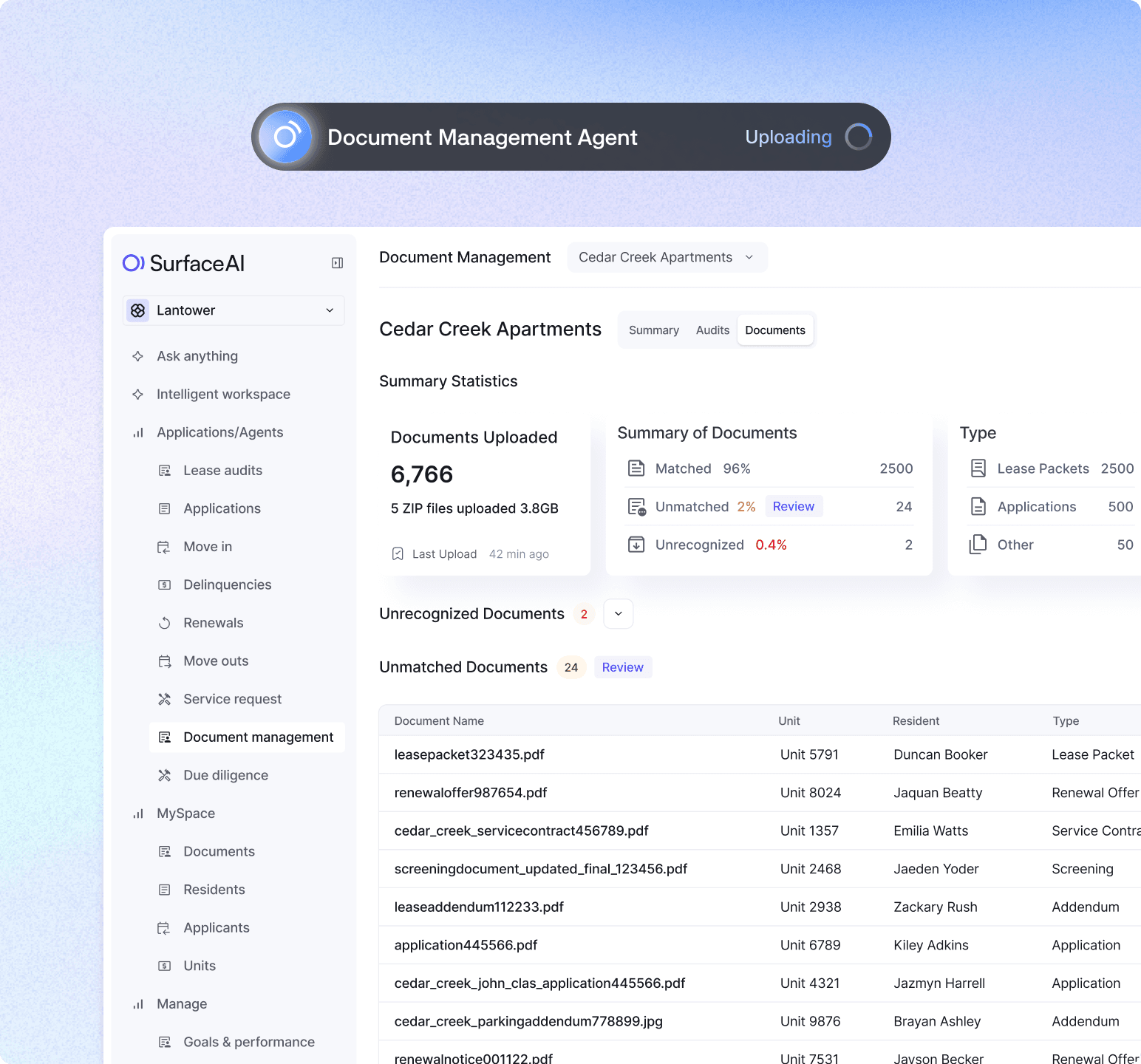
SurfaceAI enhances real estate document management by adding an intelligence layer to document workflows. Rather than functioning as a storage platform, SurfaceAI operates as a validation layer:
- Analyzing lease documents
- Verifying document completeness
- Comparing documents to lease data
- Identifying inconsistencies across files.
See the technology in action in Lease Audit AI Agent. By continuously validating document integrity, operators gain confidence in their portfolio data rather than discovering errors months after they occurred.
The Future of Document Management in Real Estate
The next generation of document management real estate systems will combine centralized storage:
- AI-driven document classification
- Automated lease term extraction
- Portfolio-wide document validation
- Compliance monitoring into a single continuous workflow.
Rather than relying on manual document review, operators will gain automated oversight across thousands of documents in real time.
Commercial Observer’s review of the real estate AI stack frames the trajectory well:
The companies seeing the greatest returns are those that deploy AI where it quietly eliminates friction. Document review is consistently one of the most impactful places to start.
For large portfolios, this transition will essentially:
- Improve operational transparency
- Reduce legal exposure
- Protect NOI at a level that manual processes simply cannot match.
FAQs about Real Estate Document Management Software for Multifamily

Related content