
Multifamily Property Management AI Features Comparison: What Actually Matters

Artificial intelligence is being added to nearly every multifamily property management system.
From leasing automation to analytics dashboards, vendors are positioning AI as a core capability. But for operators, the real question is not whether AI exists in a system.
It is how that AI actually performs in real-world workflows.
A meaningful multifamily property management AI features comparison goes beyond surface-level functionality. It evaluates how different systems support operations, accuracy, and decision-making. AI adoption for property management jumped from 20% in 2024 to 58% in 2025.
Generative AI enables a growing range of efficiencies. It reduces time spent on administrative functions. NAR documents how managers can redirect that time to higher-value work →
Why Comparing AI Features Is Difficult
Most platforms describe AI in similar terms:
- Automation
- Insights
- Predictive analytics
- Workflow optimization
On paper, these features appear comparable.
In practice, they operate very differently depending on:
- How the system is designed
- What data it uses
- How workflows are structured
Determining which multifamily system has the best AI features is difficult without understanding how those features are applied in practice.
Core Categories of AI Features in Multifamily Systems
Breaking AI into functional categories makes comparison easier. Each category adds value in different ways. Each also has its own limitations.
1. Leasing and Communication AI
These features focus on:
- Responding to inquiries
- Scheduling tours
- Assisting with leasing workflows
They improve speed and reduce workload, but they’re primarily communication tools. They don’t address deeper operational challenges like lease accuracy or revenue integrity.
2. Workflow Automation AI
Workflow AI automates:
- Task assignments
- Notifications
- Repetitive operational steps
This builds on automation concepts outlined in property management workflow automation →
These features improve efficiency, but they depend heavily on structured workflows.
3. Predictive Analytics and Forecasting
Predictive AI analyzes historical data to forecast:
- Occupancy trends
- Rent performance
- Maintenance needs
These tools help with planning and strategy.
However, their accuracy depends entirely on the quality of input data. Data analytics applies to rent roll analysis, financial reporting, and property management. It delivers faster insights and actionable context. NAIOP documents how it also enables task automation across multifamily portfolios →
4. Reporting and Dashboard Intelligence
Some systems provide AI-enhanced dashboards that:
- Surface key metrics
- Identify trends
- Highlight anomalies
They improve visibility, but often remain reactive, showing you what already happened rather than catching issues in real time.
5. Data Validation and Document Intelligence
This is where SurfaceAI operates. Validation AI works at the document level, extracting and cross-referencing data from:
- Leases
- Rent rolls
- Financial records
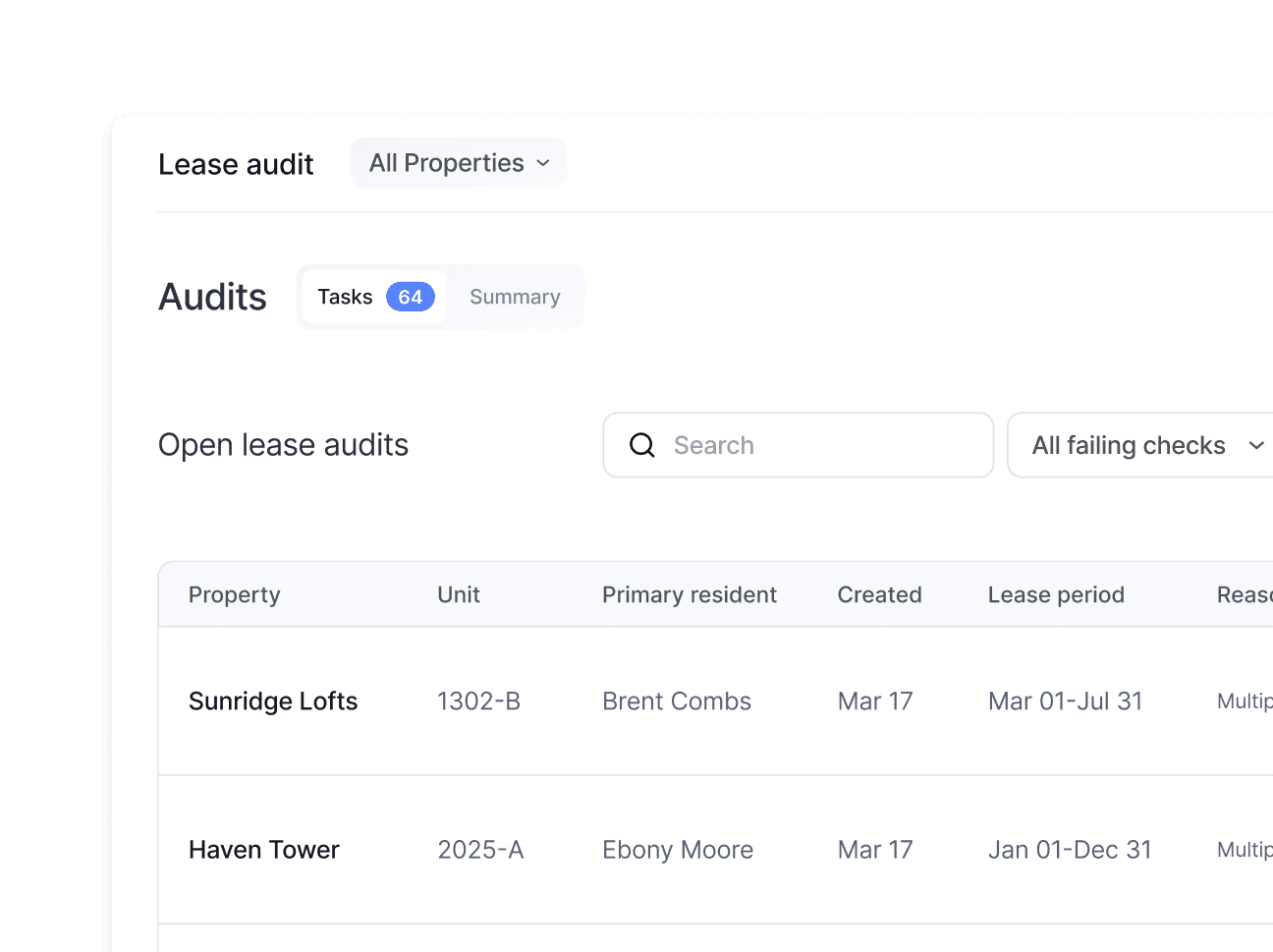
to catch missing charges, undocumented concessions, and compliance gaps. Unlike the categories above, it addresses the root cause of most operational errors: inaccurate data. By ensuring data integrity at the source, it makes every other AI feature, from analytics to automation, more reliable.

“I’ve been thoroughly impressed with the Surface AI lease audit product. It’s exceptionally user-friendly, and the audit results are clear, concise, and easy to interpret. The impact on our student teams has been tremendous—what once took several days can now be completed in just a few hours. The tool also makes it simple to identify and address issues efficiently. I can’t speak highly enough about the value this product brings.”
Amanda Pour, Operations Compliance Manager
Where Most AI Comparisons Fall Short
Most comparisons focus on:
- Number of AI features
- User interface
- Vendor claims
This misses a critical factor: whether the AI improves real operational outcomes.
For example:
- Does it reduce revenue leakage?
- Does it improve lease accuracy?
- Does it detect operational risk early?
Without answering these questions, comparisons remain superficial. Traditional real estate operations have been manual and people-focused. More volume historically meant more employees. NAIOP documents why property management, underwriting, and due diligence have all relied on headcount rather than smarter systems.
The Missing Category: Data Validation AI
One category is often overlooked in AI comparisons: data validation and verification.
Most AI systems assume that:
- Lease data is accurate
- Financial records are correct
- Documents align with system data
In reality, this is not always the case.
Errors in underlying data can:
- Distort analytics
- Impact reporting
- Reduce decision accuracy
This creates a gap between what AI predicts and what is actually happening.
How SurfaceAI Changes the Comparison
SurfaceAI operates in this missing category.
Rather than focusing on communication or workflow automation, it focuses on validating the data that drives multifamily operations.
This includes:
- Analyzing lease documents
- Validating rent roll accuracy
- Identifying discrepancies between systems and documents
- Surfacing operational risks
This positions SurfaceAI differently from traditional multifamily systems.
It does not replace property management platforms.
It strengthens them by ensuring that the data they rely on is accurate.
This becomes particularly important in workflows like those described in lease auditing and automation →

Comparing AI Features Across Systems
A more useful comparison framework looks like this:
Efficiency AI
This is where most platforms concentrate their AI efforts. These tools reduce manual workload and speed up leasing, but primarily address front-end operations.
Platform |
Key AI Feature |
|---|---|
| Yardi | Chat IQ for resident and prospect communication |
| Entrata | ELI+ for lead responses and tour scheduling |
| AppFolio | Realm-X for leasing and accounting tasks |
| RealPage | Knock CRM for multichannel prospect automation |
| Funnel Leasing | Agentic workflows for portfolio-wide lead routing |
| Zuma AI | Kelsey AI for leasing, collections, and voice AI |
Insight AI
These platforms help operators spot trends and plan ahead, but their outputs are only as reliable as the data flowing into them.
Platform |
Key AI Feature |
|---|---|
| RealPage | AI-powered revenue management and pricing forecasts |
| MRI Software | Portfolio-level visibility across multi-asset portfolios |
| Yardi | Financial reporting and compliance tracking |
Validation AI
This is the least addressed category, yet arguably the most critical. If lease data contains errors or rent rolls don’t match actual terms, every tool built on that data is compromised.
Platform |
Key AI Feature |
|---|---|
| SurfaceAI | Document-level lease extraction, cross-referencing, and continuous discrepancy detection |
SurfaceAI doesn’t compete with platforms like Yardi, RealPage, or Entrata. It integrates with them as a validation layer, ensuring the data powering your efficiency and insight tools is actually accurate.
Which Multifamily System Has the Best AI Features?
There is no single answer, because no single system does everything well.
The best system depends on what the operator prioritizes:
- Efficiency → Leasing and workflow automation tools that reduce manual tasks and speed up response times.
- Insights → Analytics platforms that surface trends, occupancy forecasts, and portfolio-level performance data.
- Accuracy → Validation-focused systems that ensure the underlying data is correct before any analysis happens.
Operators often assume one platform should cover all three. In reality, the most effective approach layers purpose-built tools on top of your core PMS.
SurfaceAI acts as a validation and intelligence layer. It strengthens the accuracy of the systems you already use. It does not replace them.
AI in Real Estate Acquisition and Multifamily Operations
AI is increasingly being used in acquisition workflows.
This includes:
- Analyzing property performance
- Modeling financial outcomes
- Evaluating risk
As discussed in real estate investment analysis tools for acquisitions, these tools depend heavily on data quality.
This reinforces the importance of validation alongside analytics. AI tools are now integrated into investment decision-making. Key use cases include market analytics, risk assessment, and automated valuations. NAR documents how this is reshaping how investors evaluate assets →
How to Evaluate AI Features in Multifamily Systems
Comparing feature lists doesn’t tell you which system will actually perform. Operators should evaluate AI based on what it delivers in practice:
Data Reliability: Is the AI working from verified source data, or just processing whatever’s in the system? SurfaceAI’s agents validate directly from lease documents, ensuring the data feeding your decisions is accurate before any analysis begins.
Workflow Integration: Does it plug into your existing PMS and processes, or require an overhaul? SurfaceAI integrates with platforms like Yardi and RealPage, adding intelligence without disrupting established workflows.
Scalability: Can it maintain the same level of oversight across 500 units as it does across 5,000? AI should scale with your portfolio, not require proportional staff increases.
Outcome Impact: Does it measurably improve revenue, efficiency, or visibility? The right AI catches billing errors, missed charges, and compliance gaps that directly affect NOI.
This framework moves the conversation from features to results.
The Future of AI in Multifamily Systems
AI in multifamily property management is evolving beyond:
- Automation
- Dashboards
- Predictions
Toward:
- Real-time validation
- Continuous monitoring
- Operational intelligence
This shift will redefine how systems are evaluated. CRE companies are using AI to improve efficiency across lease management, building operations, and portfolio assessment. Data quality is the foundational requirement. NAIOP documents why collecting and sharing clean data determines whether AI delivers its full potential →
Key Takeaway
A meaningful multifamily property management AI features comparison goes beyond surface-level functionality.
It requires understanding:
- How AI supports workflows
- How it impacts decision-making
- How it ensures data accuracy
Operators who evaluate AI through this lens gain a clearer view of what actually matters.
Conclusion
AI is becoming a core component of multifamily property management systems.
But not all AI features are created equal.
Some improve efficiency. Others provide insights. Few ensure accuracy.
Understanding these differences is critical when evaluating systems.
Book a demo to see how SurfaceAI complements existing systems. See how it supports data accuracy, lease validation, and operational risk management across your multifamily portfolio.
Frequently Asked Questions About Multifamily Property Management AI Features

Related content