
Document Automation Tools: Enterprise Solutions for Real Estate Operations

Document-heavy workflows remain one of the most operationally intensive parts of real estate.
Lease agreements, addenda, compliance records, financial documents, and resident files all move through multiple systems and teams. In most organizations, these processes are still partially manual.
This creates:
- delays in execution
- inconsistencies in data
- increased operational risk
- dependency on staff for repetitive tasks
Document automation tools transform how teams process, validate, and manage documents at scale. They replace manual steps with consistent, repeatable workflows.
What Are Document Automation Tools?
Document automation tools are systems that automate the creation, processing, and handling of documents across business workflows.
These tools replace manual tasks such as:
- data entry
- document classification
- file routing
- validation checks
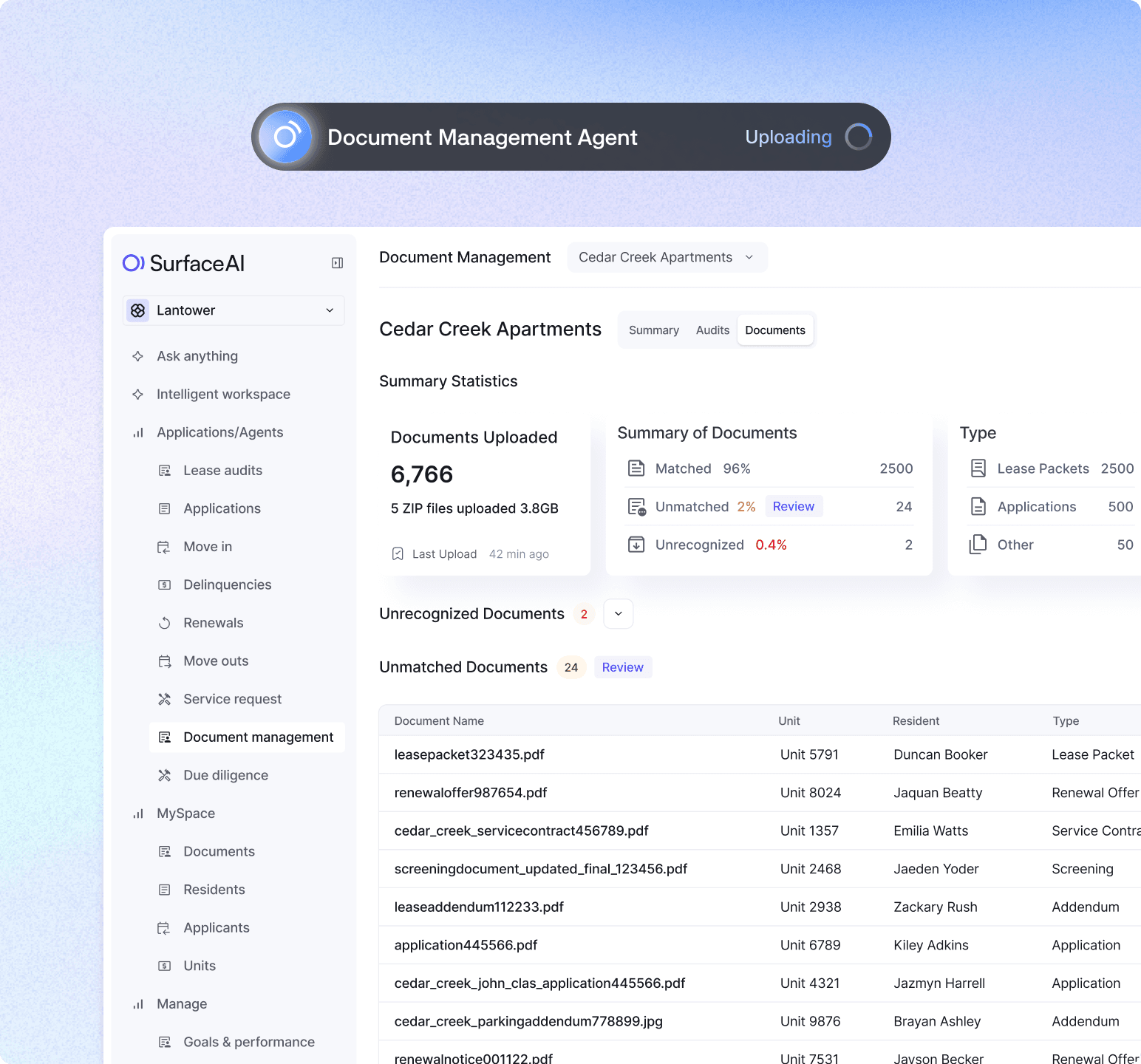
Instead, document process automation software ensures that documents move through systems consistently and accurately. AI-powered document process automation software ensures documents move through systems consistently and accurately.
Teams convert lease records, invoices, and essential documents into structured formats suitable for reporting and analysis. Deloitte documents how optical character recognition with cognitive technologies enables this transformation, replacing manual scanning with automated extraction and validation.
Why Document Automation Is Becoming Critical
As portfolios grow, document volume increases significantly.
Operators must manage:
- thousands of lease files
- recurring compliance documentation
- financial records across properties
Manual processes cannot scale effectively.
This is why business document automation is becoming a core part of operational infrastructure — especially in environments where accuracy directly impacts revenue and compliance.
For a broader view of how documents move across systems, see document workflow automation in real estate operations →
Types of Document Automation Solutions
Document automation solutions vary based on their function within the workflow.
Document Creation and Generation
These tools automate:
- lease creation
- contract generation
- standardized document templates
They ensure consistency across documents.
Document Processing Automation
Document process automation software focuses on:
- extracting data from documents
- structuring unstructured information
- validating document content
This is particularly important for lease documents and financial records.
Workflow and Routing Automation
These tools automate how documents move across systems.
This includes:
- assigning tasks
- routing documents to teams
- triggering workflows
Enterprise Document Automation Platforms
Enterprise document automation systems operate across multiple properties and teams.
They provide:
- centralized control
- integration with existing systems
- scalability across portfolios
These platforms are designed for institutional operators rather than small portfolios.

Enterprise Document Automation in Real Estate
Enterprise document automation is not just about efficiency.
It is about control.
At scale, operators need to ensure:
- documents are accurate
- workflows are consistent
- data is aligned across systems
Without automation, this requires significant manual effort.
With automation, these processes become standardized and repeatable. Agentic AI makes real estate documents usable by collecting clean lease, vendor, and property metadata. It serves as a clear source of truth when systems disagree. McKinsey documents how this factual layer is the foundation for effective document automation in real estate →
Document Automation Tools for Regulated Industries
Real estate operates within a regulated environment.
Document automation tools for regulated industries must support:
- audit trails
- compliance tracking
- document version control
- secure data handling
This is especially important for:
- lease compliance
- financial reporting
- regulatory documentation
Automation ensures that processes are consistent and defensible. Real estate companies can automate routine risk and compliance monitoring. This includes tracking invoices against contractual terms and reviewing lease contracts for potential tenant defaults. Deloitte documents how automation makes these processes consistent and defensible →
Business Document Automation in Property Operations
Business document automation extends beyond storage.
It connects documents directly to operational workflows.
For example:
- lease data triggers billing systems
- compliance documents trigger workflows
- financial documents support reporting
This integration ensures that documents are not isolated from operations.
Role of Document Automation Companies
Many organizations rely on document automation companies to implement solutions.
These companies provide:
- implementation services
- workflow design
- system integration
However, effectiveness depends on how well these solutions integrate with existing systems.
Without proper integration, automation becomes fragmented.
Where Document Automation Tools Fall Short
Even advanced tools can have limitations.
Common gaps include:
- lack of real-time validation
- incomplete integration with operational systems
- reliance on structured templates only
- inability to handle unstructured documents
These limitations are most visible in real estate, where documents vary widely in format.
Connecting Document Automation to Real Estate Workflows
Document automation tools must align with how real estate operations actually function.
This includes:
- leasing workflows
- compliance processes
- financial reporting
- property transitions
When automation is disconnected from workflows, it creates inefficiencies instead of reducing them.
This is why document automation is closely tied to property management workflow automation →
The Shift Toward Intelligent Document Processing
Modern document automation is moving beyond basic workflows.
Operators are adopting:
- intelligent document classification
- automated validation
- real-time processing
This shift reduces:
- manual intervention
- processing delays
- operational inconsistencies
It also improves data accuracy across systems.
Why Document Automation Matters at Scale
At small scale, manual processes may be manageable.
At portfolio scale, they create risk.
This includes:
- missed data points
- incorrect document handling
- delays in workflows
- compliance exposure
Document automation tools provide a structured way to handle this complexity.
Choosing the Right Document Automation Solution
When evaluating document automation tools, operators should focus on:
- scalability across properties
- ability to handle unstructured documents
- integration with existing systems
- workflow automation capabilities
- compliance support
The best document automation solution is one that aligns with real operational workflows.
Key Takeaway
Document automation tools are no longer optional for real estate operators.
They are essential for:
- managing document-heavy workflows
- maintaining data accuracy
- supporting compliance
- scaling operations efficiently
Operators who rely on manual processes face increasing operational risk as portfolios grow.
Conclusion
As real estate operations become more complex, document workflows must evolve.
Automation provides a way to:
- reduce manual workload
- improve consistency
- increase visibility across systems
For operators managing large portfolios, document automation is not just about efficiency, it is about maintaining control.
Book a demo to see how modern automation layers integrate with existing property management platforms. See how they improve document accuracy at scale.
Frequently Asked Questions About Document Automation Tools