
SurfaceAI: Automated Lease Auditing Solution

Lease auditing software automates the review of lease agreements to verify charges, flag compliance gaps, and surface missing documentation, replacing manual spreadsheet audits with continuous, system-connected oversight. For multifamily operators managing hundreds or thousands of units, the difference between periodic spot-checks and real-time monitoring often shows up directly in NOI.
This guide covers how lease audit software works, what distinguishes it from lease accounting tools, and how to evaluate solutions for your portfolio.
What Is Lease Auditing Software
Lease auditing software automates the review of lease agreements to verify that charges are accurate, terms are compliant, and documentation is complete. Rather than relying on spreadsheets and periodic spot-checks, lease audit software connects directly to property management systems and monitors lease data continuously. When a discrepancy appears, a missed charge, an unsigned document, a concession that exceeds policy, the system flags it immediately.
This category of software differs from lease accounting software, which focuses on financial reporting standards like ASC 842 or IFRS 16. Lease accounting tools help accountants prepare journal entries and amortization schedules. Lease auditing software, on the other hand, helps operations teams catch errors before they hit the bottom line. Many organizations use both, but they solve different problems for different users.
Why Multifamily Operators Need Automated Lease Audit Software
Manual lease audits worked when portfolios were smaller and lease terms were simpler. Today, high lease volumes across 22.4 million rental households, frequent renewals, and complex concession structures make periodic reviews impractical. The consequences show up in three places: revenue, compliance, and staff capacity.
The National Apartment Association reports that the average multifamily property experiences 40–60% annual turnover. Lease files are constantly changing, and when audits happen only at month-end, or quarterly, errors compound. A single missed pet fee across 500 units at $35 per month adds up to $210,000 in annual revenue leakage. Across a portfolio, the impact on net operating income becomes material.
Revenue Leakage from Missed or Incorrect Charges
Revenue leakage of 3–7% annually often hides in plain sight. The most common culprits include:
- Unapplied rent increases: Scheduled increases that never made it into the billing system
- Missing amenity fees: Parking, storage, or pet charges that were agreed to but not coded
- Concession misapplication: Move-in specials that extended beyond their intended term
Without automated comparison between lease terms and actual charges, errors like these persist until someone manually reviews the file. In many cases, that review never happens.
Compliance Exposure from Unsigned or Out-of-Policy Leases
Unsigned lease documents and out-of-policy terms create legal and financial risk that compounds over time. An unsigned addendum may seem minor until a dispute arises and the operator has no enforceable documentation. Similarly, a concession that exceeds company policy, approved informally by a leasing agent, can set a precedent that’s difficult to reverse.
In rent-controlled jurisdictions, documentation errors carry even higher stakes. A 2023 survey by the Institute of Real Estate Management (IREM) found that 41% of property management firms cited compliance-related issues as a top operational concern.
Manual Audit Backlogs and Spreadsheet Fatigue
Reliance on spreadsheets and periodic reviews creates lease audit backlogs that never quite clear. Site teams spend hours reconciling rent rolls against lease files, often duplicating work from the previous month. Regional managers, meanwhile, lack confidence that the data they’re seeing reflects reality, with 60% reporting monthly financial discrepancies.
The operational drag is significant. Staff time spent hunting for discrepancies is time not spent on leasing, resident engagement, or retention, activities that directly impact occupancy and revenue.
Key Features of a Lease Audit Software Solution
Effective lease audit software combines monitoring, verification, and workflow automation into a single system. The goal is to surface issues automatically so teams can act on them, rather than discover them after the damage is done.
Real-Time Lease Monitoring
The software syncs with property management systems and triggers audits whenever a lease is created, modified, or renewed. This differs fundamentally from batch processing at month-end. Real-time monitoring catches errors when they occur, not weeks later during reconciliation.
Automated Charge and Fee Verification
The system compares lease terms against actual charges in the billing system. When a discrepancy appears – a missing fee, an incorrect rent amount, an unapplied increase – it’s flagged immediately. This eliminates the need for manual line-by-line comparison.
Policy Compliance Checks
Beyond charge verification, lease audit software validates terms against company policies. If a concession exceeds approved limits, or if a lease contains non-standard language, the system flags it for review. This protects operators from informal approvals that create downstream risk.
Task Assignment and Workflow Automation
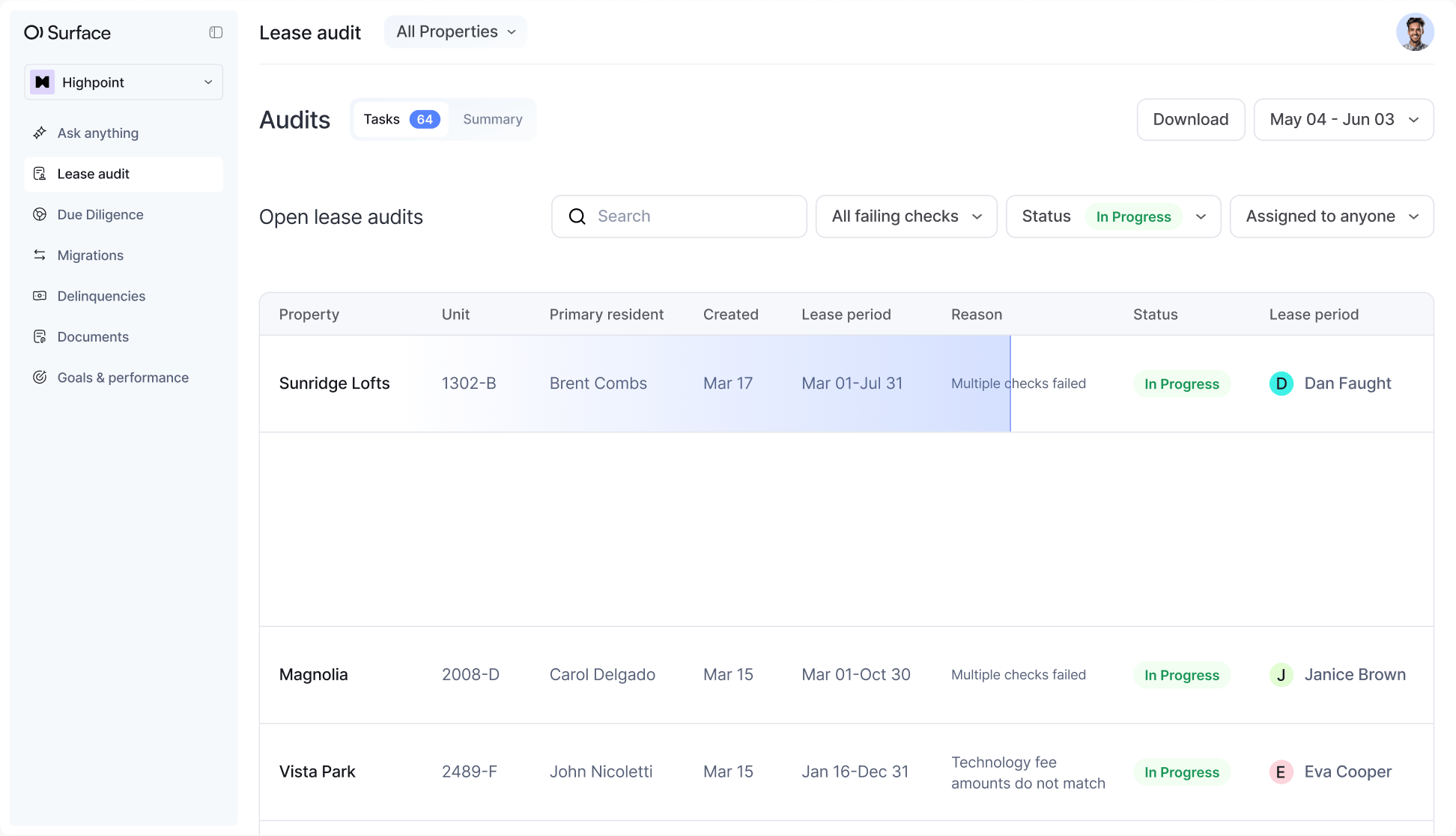
Flagged issues are routed to the appropriate staff member with clear action items. Instead of a spreadsheet sitting in someone’s inbox, the system creates trackable tasks with deadlines and accountability. This closes the loop between detection and resolution.
Unified Data from PMS, Rent Rolls, and Lease PDFs
Modern lease audit solutions pull data from multiple sources, structured data from the PMS, unstructured data from lease PDFs, even email threads where approvals were documented. SurfaceAI’s Lease Audit Agent, for example, integrates with core systems and cloud storage to unify data from every corner of operations.
How AI-Powered Lease Tracking Software Works
The workflow follows a predictable sequence. First, the system connects to the property management system and pulls current lease data, rent rolls, and associated documents. Next, when a lease is created or modified, an audit runs automatically, no manual initiation required.
From there, AI compares lease terms against charges, policies, and documentation requirements, flagging discrepancies. Flagged issues are then assigned to the appropriate team member with context and recommended actions. Finally, the system monitors whether issues are resolved and maintains a complete audit trail.
What makes AI-powered solutions different is their ability to handle unstructured data. A traditional rules-based system can compare fields in a database. A lease audit AI agent can read a lease PDF, extract relevant terms, and compare them against what’s in the PMS, even when formatting varies across documents.
SurfaceAI’s approach takes this further with continuous monitoring. Most audits are one-and-done. SurfaceAI’s Lease Audit Agent runs 24/7, catching errors the moment they appear rather than waiting for the next scheduled review.
Benefits of Continuous Lease Auditing for Property Operations
The shift from periodic to continuous auditing changes the economics of lease oversight. Instead of discovering problems after they’ve compounded, operators catch them in real time.
Catch Errors Before Month-End Close
When audits run continuously, discrepancies surface within hours of a lease change, not weeks later during reconciliation. This real-time financial monitoring gives teams time to correct errors before they affect financial reporting or resident billing.
Recover Revenue Without Manual Chasing
Automated flagging and task assignment accelerate revenue recovery. Instead of staff hunting through files to find missing charges, the system identifies them and routes them for action. The difference between discovering a missed charge in week one versus month three can be substantial.
Maintain Compliance Without Periodic Spot-Checks
Continuous oversight replaces reactive, incomplete spot-checks with proactive, portfolio-wide monitoring. Every lease change is reviewed against policy, every document status is tracked, and every exception is logged. This creates the audit trail that institutional investors and compliance teams require.
Lease Auditing Software vs Lease Accounting Software
Searchers often conflate lease auditing software and lease accounting software, but they serve different purposes and different users.
| Feature | Lease Auditing Software | Lease Accounting Software |
|---|---|---|
| Primary purpose | Operational accuracy and compliance | Financial reporting and journal entries |
| Primary users | Property managers, operations teams | Accounting and finance teams |
| Key outputs | Flagged discrepancies, task assignments | Amortization schedules, disclosure reports |
| Standards focus | Company policies, lease terms | ASC 842, IFRS 16, GASB 87 |
| Timing | Continuous, real-time | Periodic, aligned with close cycles |
Lease accounting software, tools like FinQuery, Trullion, or Visual Lease, helps accounting teams comply with financial reporting standards. Lease auditing software helps operations teams ensure that what’s in the lease matches what’s being charged and that documentation is complete.
How Lease Software Integrates with Property Management Systems
Effective lease audit software connects to the systems property teams already use. Integration typically includes property management systems like Yardi, RealPage, AppFolio, and Entrata, along with cloud storage platforms like OneDrive, SharePoint, and Google Drive. Document repositories containing lease files, addenda, notices, and correspondence are also connected.
Integration eliminates duplicate data entry and manual exports. When a lease is signed in the PMS, the audit system sees it immediately. When a document is uploaded to cloud storage, it’s automatically matched to the correct resident and lease.
SurfaceAI’s platform is designed around this principle – connecting to core systems and storage tools to unify data from every corner of operations.
Reporting and Audit Trails in Lease Accounting Systems
Operators evaluating lease audit software often ask about reporting capabilities. The right system provides several key report types:
- Issue summary reports: Overview of flagged discrepancies by property or portfolio
- Resolution tracking: Status of open vs. resolved items with timestamps
- Audit history: Complete log of all lease changes and audit results
- Compliance reports: Documentation status and policy adherence metrics
Reporting matters for more than internal management. Institutional investors increasingly require audit trails as part of due diligence. Lenders may request compliance documentation during refinancing. Having a defensible, timestamped record of lease oversight reduces friction in these processes.
Implementation and Onboarding for Lease Audit Software
A common concern is implementation complexity. Modern lease audit solutions prioritize rapid deployment with minimal IT lift. Typical onboarding involves connecting to the property management system via API or secure data sync, configuring audit rules based on company policies and lease structures, mapping document storage locations for unstructured data, and training staff on the workflow and task management interface.
Most implementations complete within weeks, not months. SurfaceAI’s approach emphasizes getting properties ready quickly without lengthy setup periods or extensive IT involvement.
How to Choose the Right Lease Software for Your Portfolio
Not all lease audit solutions are built the same. When evaluating options, several factors matter most.
Continuous Monitoring vs Periodic Audits
Some tools run audits on a schedule, weekly, monthly, or on-demand. Others monitor continuously and trigger audits on every lease change. Continuous monitoring catches more issues and catches them faster.
Multifamily-Specific Capabilities
Generic lease software may lack features for resident leases, concessions, and multifamily workflows. Solutions built specifically for apartment management tend to handle the operational realities of the industry more effectively.
Integration with Existing Systems
Compatibility with your current PMS, cloud storage, and document management tools is essential. A solution that requires manual data exports defeats the purpose of automation.
Portfolio Size and Complexity
The right software scales with your portfolio. A solution that works for 500 units may struggle at 5,000. Evaluating performance and pricing at your current size and projected growth helps avoid future migration headaches.
Automate Lease Auditing Across Your Multifamily Portfolio
Manual lease audits served their purpose when portfolios were smaller and lease terms were simpler. That era has passed. Today, the volume of lease changes, the complexity of concession structures, and the stakes of compliance errors demand a different approach.
Automated lease auditing transforms a reactive, labor-intensive process into a continuous, scalable capability. Errors surface when they occur, not weeks later. Revenue recovery happens without manual chasing. Compliance is maintained without periodic fire drills.
SurfaceAI’s Lease Audit Agent is built around this principle, continuous oversight that runs 24/7, catching errors and revenue leaks the moment they appear.

“I’ve been thoroughly impressed with the Surface AI lease audit product. It’s exceptionally user-friendly, and the audit results are clear, concise, and easy to interpret. The impact on our student teams has been tremendous—what once took several days can now be completed in just a few hours. The tool also makes it simple to identify and address issues efficiently. I can’t speak highly enough about the value this product brings.”
Gary Robbins, Transitions Manager
FAQs about Lease Auditing Software

Related content