AI Real Estate Deal Analyzer: Smarter Tools for Investors and Underwriting Teams

Real estate deal analysis has traditionally meant spreadsheets, manual data entry, and hoping nothing slips through the cracks before closing. For acquisition teams reviewing hundreds of units under tight timelines, that approach creates real exposure, missed revenue, undisclosed concessions, and resident risk factors that surface only after the wire transfer clears.
AI deal analyzers change the equation by automating data extraction from rent rolls and lease documents, flagging financial and compliance red flags, and compressing due diligence from days to hours. This article covers how these tools work, what features matter most, and how investors and underwriting teams can use AI to make faster, more confident acquisition decisions.
What Is an AI Real Estate Deal Analyzer
An AI real estate deal analyzer is software that uses machine learning to evaluate investment properties by automatically extracting and analyzing data from rent rolls, leases, and financial documents. Rather than requiring manual data entry into spreadsheets, AI deal analyzers ingest unstructured files – scanned PDFs, lease addenda, email attachments, and pull out the numbers and terms that matter for underwriting decisions.
The distinction from traditional analysis tools is significant. Basic deal calculators ask you to type in rent amounts, expenses, and assumptions. AI deal analyzers read the source documents themselves, cross-reference the data, and flag inconsistencies before you even know to look for them.
For investors and underwriting teams working under tight timelines, manual deal analysis introduces real risk. Errors slip through. Discrepancies between rent rolls and lease terms go unnoticed. Unsigned documents surface after closing. Each of these issues affects net operating income or creates compliance exposure that becomes expensive to resolve.
AI deal analyzers typically deliver three core capabilities:
- Data extraction: Automatically pulls figures from PDFs, rent rolls, and lease documents using optical character recognition and document parsing
- Risk detection: Flags financial anomalies, resident risk factors, and compliance gaps based on configurable rules
- Workflow automation: Routes findings to team members for action rather than generating static reports
What an AI Deal Analyzer Actually Does
A practical AI deal analyzer supports several core workflows:
1. Lease and Document Review
AI parses executed leases, amendments, and addenda to ensure underwriting inputs reflect real contract terms.
2. Financial Alignment Checks
It verifies that projected cash flows align with lease obligations and rent schedules.
3. Risk Detection
AI highlights non-standard clauses, missing charges, or unusual structures that may affect valuation.
4. Scenario Support
By structuring deal data, AI enables faster sensitivity and scenario analysis without rebuilding models from scratch.
These capabilities move deal analysis beyond surface-level modeling into deeper validation.
Why Investors and Underwriting Teams Need AI for Deal Analysis
The pace of real estate transactions has changed. CBRE forecasts CRE investment activity to reach $562 billion in 2026, and buyers who move slowly lose deals. Meanwhile, portfolios have grown larger, and the cost of discovering problems after closing has increased. AI addresses all three pressures simultaneously.
Compressed Timelines from LOI to Close
Deal velocity has accelerated across most markets. When a letter of intent is signed, the clock starts ticking. Manual lease-by-lease review cannot keep pace when hundreds of units require analysis within days, a constraint driving the shift toward automated due diligence across multifamily acquisitions.
AI compresses the timeline from days of manual work to hours of automated processing. Teams review flagged exceptions rather than reading every document, which means faster decisions without sacrificing thoroughness.
The difference between closing in two weeks versus four weeks often determines whether you win the deal at all.
Reduced Manual Error and Revenue Leakage
Spreadsheet-based audits miss things. Rent amounts that do not match lease terms. Charges that were never applied. Concessions that exceed what was disclosed. Under time pressure, even experienced analysts overlook discrepancies that AI catches consistently.
Revenue leakage from billing errors and missed charges can reach 1-3% of gross potential rent in portfolios without systematic audit processes, according to industry benchmarks from the National Apartment Association. On a 500-unit property at $1,500 average rent, that translates to $90,000-$270,000 in annual revenue at risk.
Scalable Due Diligence Across Large Portfolios
A 50-unit acquisition might be manageable with manual review. A 500-unit portfolio acquisition is not. AI enables consistent analysis across hundreds or thousands of units without proportional increases in staff time or audit costs.
The alternative, hiring temporary staff or accepting less thorough review, introduces risk that compounds as portfolios expand. Operators pursuing growth strategies find that manual processes become the bottleneck.
Why Real Estate Investors Are Turning to AI Deal Analysis
Real estate investing depends on the ability to evaluate deals quickly and accurately. Every acquisition requires careful review of leases, rent rolls, operating statements, and underwriting assumptions, often under tight timelines.
Traditional deal analysis relies heavily on spreadsheets and manual data entry, which can:
-
Slow down decision-making
-
Introduce human error
-
Limit the depth of review
-
Increase post-close risk
An AI real estate deal analyzer helps investors scale analysis without sacrificing accuracy by automating data extraction, validation, and comparison across deal inputs.
Industry coverage highlights how investors are increasingly adopting AI to make complex deal analysis more accessible and efficient.
(Reference: Nasdaq – 5 AI Tools That Make Real Estate Investing Easier →)
How AI Analyzes Real Estate Deals
Understanding what happens under the hood helps teams evaluate tools and set realistic expectations. AI deal analysis follows a structured process from data ingestion through insight delivery.
Automated Data Extraction from Rent Rolls and Leases
The process begins with ingestion:
- AI systems accept structured data like rent roll exports alongside unstructured document, lease PDFs, addenda, notices, and supporting files.
- Optical character recognition (OCR) converts scanned documents into machine-readable text.
- Document parsing then identifies key fields: resident names, unit numbers, rent amounts, lease dates, and charge codes.
This extraction step eliminates the most time-consuming part of manual analysis. Instead of opening each file, finding the relevant information, and entering it into a spreadsheet, lease automation technology handles extraction automatically.
Financial and Demographic Red Flag Detection
Once data is extracted, AI applies rules and pattern recognition to identify anomalies. The specific flags depend on configuration, but common examples include:
- Rent amounts that do not match lease terms
- Residents with prior evictions or bankruptcies
- Unsigned or missing lease documents
- Out-of-policy concessions or lease terms
- Payment history indicating delinquency risk
- Occupancy patterns that suggest fraud or misrepresentation
Red flag detection surfaces issues that would otherwise require line-by-line comparison across multiple documents. Under typical deal timelines, that level of manual scrutiny rarely happens.
Workflow Automation from Insight to Task Assignment
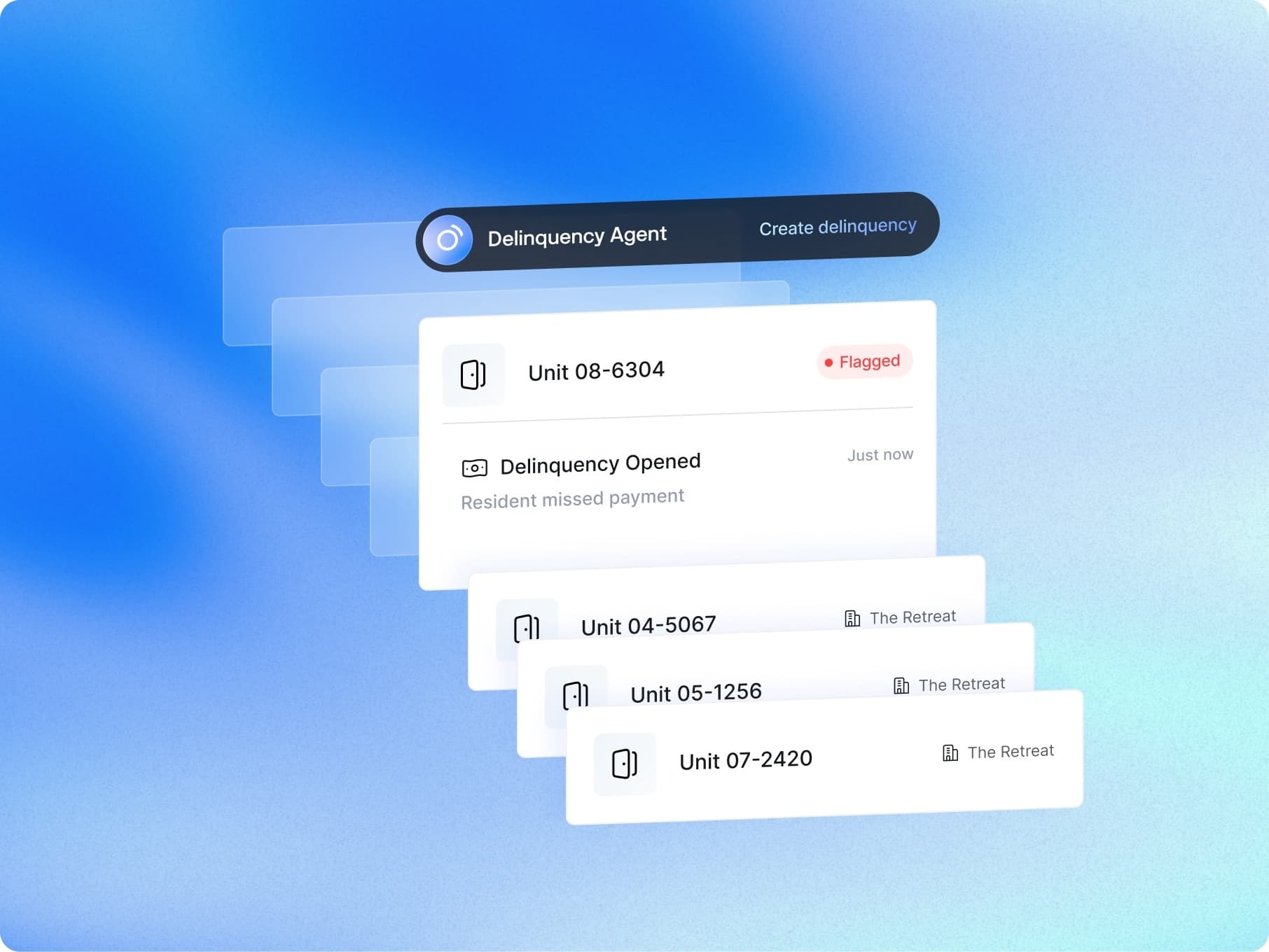
Modern AI deal analyzers do more than generate reports. They assign tasks to staff, trigger follow-ups, and integrate into operational workflows. A flagged discrepancy becomes an assigned task with a deadline, not a line item in a PDF that someone might review later.
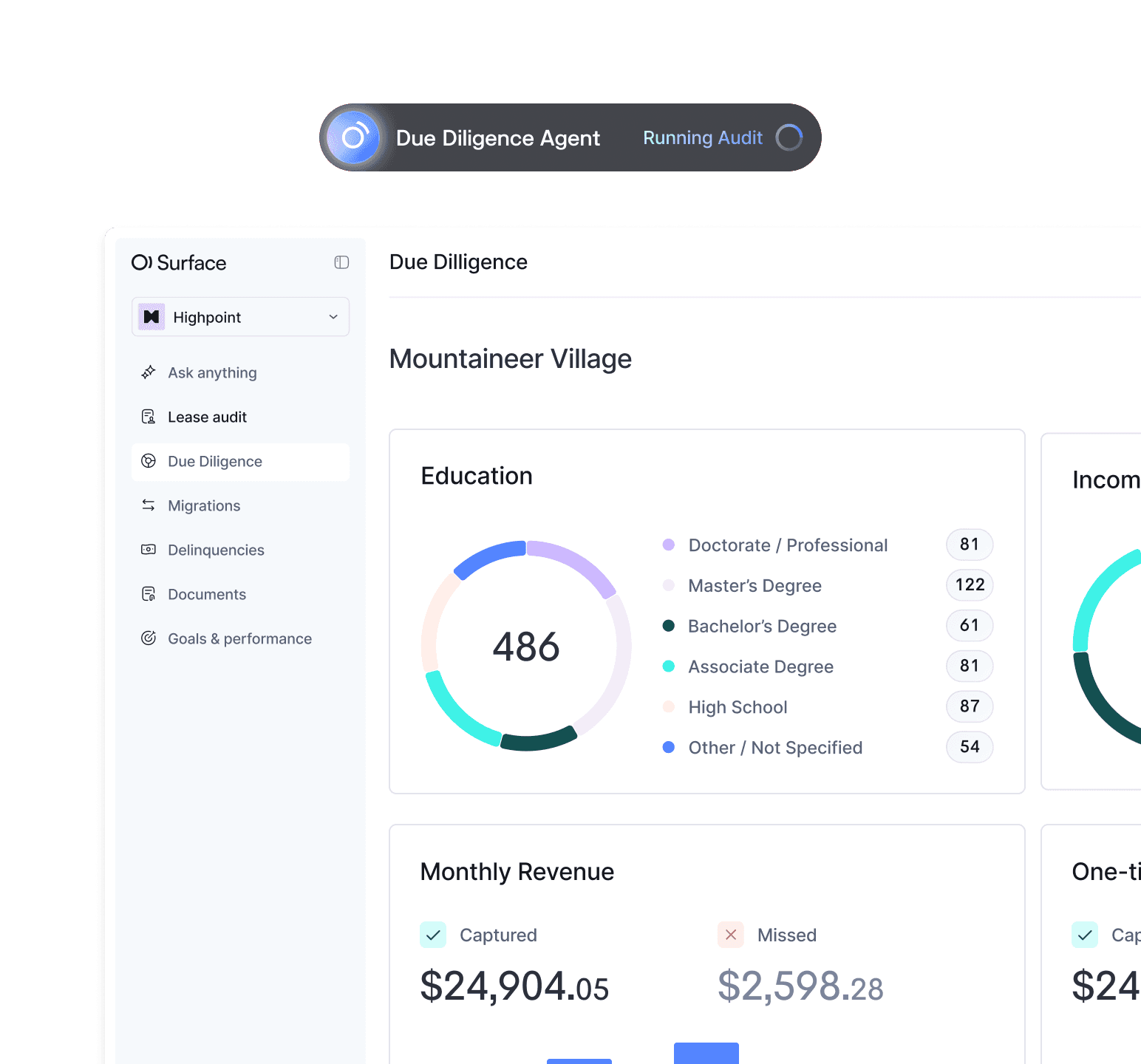
SurfaceAI’s Due Diligence Agent, for example, routes exceptions directly to team members within the same workspace where they manage other property operations. The finding and the action happen in one place.
How AI Improves Real Estate Underwriting
Underwriting requires synthesizing large volumes of structured and unstructured data. AI enhances this process by:
Automating Data Extraction
AI reads lease agreements and financial documents to extract rent terms, escalations, renewals, and obligations, reducing manual effort.
Validating Assumptions
AI compares extracted lease terms against underwriting models to flag mismatches before they impact investment decisions.
Improving Consistency
Unlike manual review, AI applies the same logic across every document, reducing variability in analysis.
Highlighting Risk Patterns
Machine learning models can identify trends or anomalies that warrant deeper review, helping investors focus attention where it matters most.
For a broader view of how this fits into acquisition workflows, see AI due diligence for real estate →
Key Features to Look for in a Real Estate Deal Analyzer
Not all deal analyzers offer the same capabilities. Basic tools provide calculators for ROI and cash flow. Enterprise platforms automate extraction, flag risks, and connect to operational systems. The difference matters when evaluating which tool fits your workflow.
| Feature | Basic Deal Analyzer | AI-Powered Deal Analyzer |
|---|---|---|
| Data input | Manual entry | Automated extraction |
| Analysis type | Static calculations | Continuous monitoring |
| Risk detection | User-defined only | AI-flagged anomalies |
| Workflow integration | Export to spreadsheet | Task assignment and PMS sync |
Continuous Monitoring vs One-Time Analysis
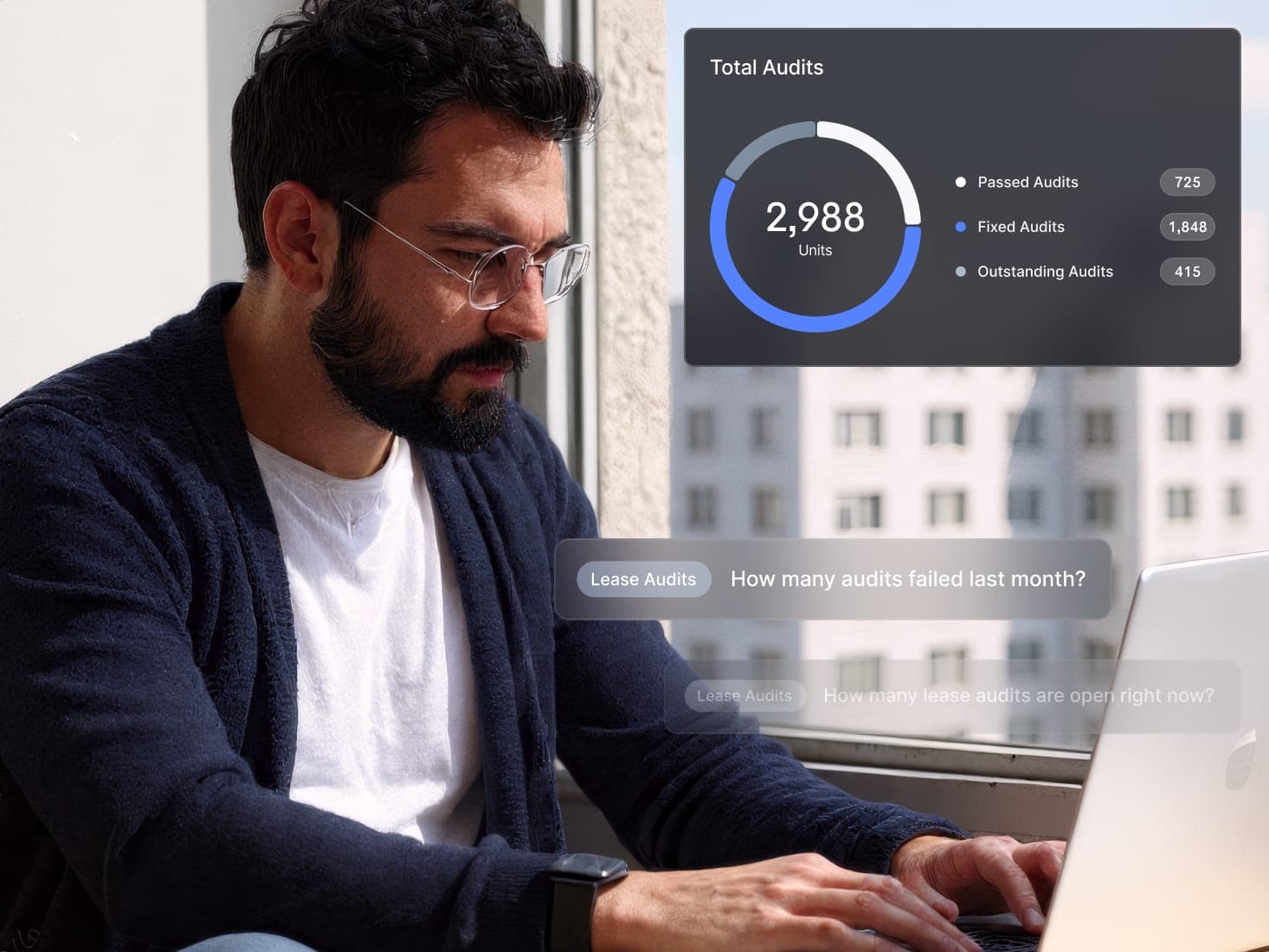
Most deal analyzers run once and produce a static output. Advanced tools audit continuously as data changes. This distinction matters because deal data evolves, sellers provide updated rent rolls, new leases get signed during due diligence, and corrections arrive throughout the process.
Continuous monitoring catches changes that one-time analysis misses. It also extends value beyond acquisition into ongoing operations, where lease discrepancies and compliance gaps continue to emerge.
Resident-Level Risk Assessment
Financial analysis alone does not capture the full picture. Resident-level risk assessment examines demographic and behavioral signals, employment status, payment history, prior evictions, bankruptcy records – that indicate future performance.
A property might show strong current collections while harboring residents with deteriorating credit or employment situations. AI surfaces resident-level risks before they become collection problems.
Integration with PMS and Cloud Storage
The most useful deal analyzers connect directly to property management systems like Yardi, RealPage, and AppFolio, as well as cloud storage platforms like OneDrive and SharePoint. Direct integration eliminates manual uploads and ensures analysis reflects current system records.
Without integration, teams spend hours preparing data for analysis, time that could go toward reviewing findings and making decisions.
Permission-Aware Access and Data Security
Lease and resident data is sensitive. Reputable AI platforms use encryption, role-based permissions, and audit trails to protect information. Before adopting any platform, teams benefit from verifying SOC 2 compliance or equivalent security certifications.
AI Deal Analysis for Multifamily and Commercial Real Estate Portfolios
AI deal analysis applies across asset classes, though the specific applications vary. Multifamily portfolios benefit most from resident-level analysis, unit-by-unit rent roll accuracy, individual lease term verification, and demographic risk assessment across potentially thousands of residents.
Commercial real estate deal analysis focuses more on lease abstraction and tenant creditworthiness. The document complexity differs, but the underlying value proposition remains: automated extraction and risk detection that manual processes cannot match at scale.
For multifamily operators specifically, the volume of leases and the granularity of resident data make AI particularly valuable. According to Yardi Matrix, multifamily volume reached $83.2 billion in 2025, and a single 300-unit property might have 300 active leases, each with multiple documents, addenda, and payment histories. Manual review of that volume is impractical under typical multifamily deal timelines.
Real-World Applications of AI Deal Analyzers
Understanding where AI fits into existing workflows helps teams plan implementation and set expectations.
Acquisition Due Diligence and Pre-Close Risk Review
Acquisition teams use financial due diligence tools powered by AI to validate seller-provided data, surface discrepancies, and identify hidden revenue leakage before closing. The goal is confidence that the numbers supporting the purchase price are accurate.
Common findings include rent amounts that do not match lease terms, charges that were never applied, and concessions that exceed what was disclosed. Each finding represents either recovered value or avoided overpayment.
Property Takeovers and Transition Audits
New management inheriting a property often faces messy files, incomplete documentation, and unclear resident status. AI provides instant visibility into lease accuracy and resident risk without weeks of manual file review.
Transition audits are especially valuable for third-party managers taking over distressed assets or portfolios from underperforming operators. The faster you understand what you have inherited, the faster you can address problems.
Ongoing Lease Audit and Compliance Monitoring
AI deal analysis does not stop at close. The same capabilities that support acquisition due diligence extend into ongoing operations, continuous monitoring for lease discrepancies, compliance gaps, and revenue leakage.
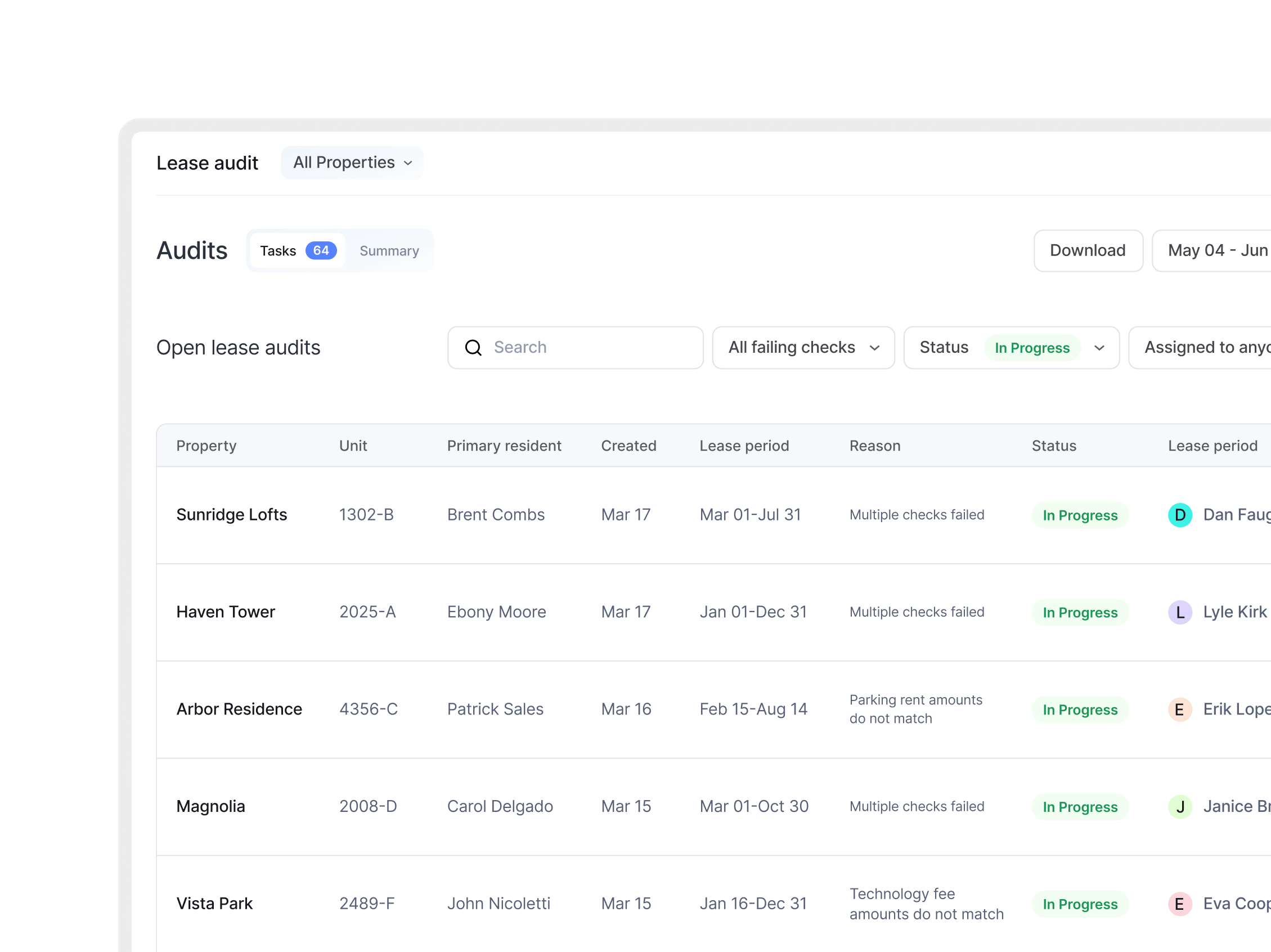
SurfaceAI’s Lease Audit Agent runs continuously rather than as a one-time review, catching issues the moment they appear rather than during periodic audits.
Free vs Enterprise Real Estate Deal Analyzer Tools
Free deal analyzer tools exist and serve a purpose. Basic ROI calculators and cash flow estimators help individual investors evaluate single properties quickly. They require manual data entry and provide static calculations without document parsing or risk detection.
For institutional-grade due diligence at scale, free tools fall short:
- Free tools: Single-property calculators requiring manual input; useful for quick estimates on individual deals
- Enterprise platforms: Multi-property analysis with automated extraction, red flag detection, and operational workflow integration
The choice depends on portfolio size, deal volume, and risk tolerance. A single-family investor evaluating one property per month has different requirements than an acquisition team reviewing 1,000 units per quarter.
Best Practices to Maximize AI Deal Analysis Results
Adopting AI deal analysis requires some preparation to achieve full value. Teams that follow a few key practices see faster implementation and better outcomes.
1. Centralize Data Before Running Analysis
AI performs best when rent rolls, leases, and supporting documents are consolidated in connected storage or property management systems. Scattered files across email attachments, local drives, and disconnected folders slow analysis and increase the chance of missing documents.
2. Define Red Flag Thresholds Aligned to Investment Criteria
Not every anomaly matters equally. Teams benefit from configuring what constitutes a flag, delinquency over a certain number of days, concessions exceeding policy limits, specific resident risk factors, based on investment criteria and risk tolerance.
3. Connect AI Insights to Operational Workflows
Analysis without action is wasted effort. The most effective implementations connect AI findings directly to task assignment and resolution tracking. Flagged issues become assigned work items with owners and deadlines, not just report line items.
AI, Decision-Making, and Investment Confidence
Beyond speed, AI contributes to better decision quality by improving consistency and reducing cognitive overload in data-heavy environments.
Research on AI-assisted decision-making shows that AI is most effective when used to support human judgment rather than replace it, especially in high-stakes contexts like investing.
(Reference: Harvard Business Review – How AI Can Help Leaders Make Better Decisions Under Pressure →)
This principle directly applies to AI-powered deal analysis in real estate.
How SurfaceAI Enhances AI Deal Analysis
SurfaceAI is not a standalone underwriting or valuation platform. Instead, it operates as an AI agent layer that strengthens deal analysis by ensuring accuracy across lease and document data.
SurfaceAI supports investment workflows through:
Lease Accuracy Validation
The Lease Audit Agent reviews executed leases to identify discrepancies between contract terms and underwriting assumptions. Learn more about the Lease Audit AI agent →
Accelerated Acquisition Review
During transactions, the Due Diligence Agent processes large volumes of leases and documents to surface risks early. See how AI due diligence for real estate ↗ supports acquisitions.
Structured Document Intelligence
The Document Management Agent organizes and validates deal documents, ensuring analysts always work from reliable source data.
Together, these agents improve confidence in deal models without disrupting existing systems.

“So much more effective to find issues rather than us dig dig dig - all in one document. The convenience is great”
Ally Goeller
Smarter Deal Analysis Starts with the Right AI Platform
AI deal analyzers have moved from novelty to necessity for competitive investors and underwriting teams. According to JLL’s 2026 Global Real Estate Outlook, 88% of investors initiated AI programs in 2025, yet only 5% report achieving most of their goals, underscoring the gap between adoption and effective implementation. The volume of data, the pace of transactions, and the cost of missed issues all favor automation over manual review.
The right platform combines automated extraction, continuous monitoring, and workflow integration. It connects to existing systems, flags risks based on configurable criteria, and routes findings to the people who can act on them.
For multifamily operators and acquisition teams, the question is no longer whether to adopt AI deal analysis, but which platform delivers the capabilities that match their workflow and scale.
Book a demo to see how SurfaceAI’s Due Diligence Agent automates deal analysis for multifamily investors.
FAQs about AI Real Estate Deal Analyzers

Related content